Transport systems are not gender-neutral. Women and men experience mobility differently — in how they travel, how safe they feel, and how much access they have to jobs and services. Women tend to make more complex, multi-stop journeys to balance paid work, caregiving, and daily errands, yet transport infrastructure and planning have historically been designed around a single male commuter model. At the same time, the sector’s workforce remains heavily male-dominated, with women underrepresented across driving, engineering, and leadership roles alike. The result is a system that falls short for a large share of its users.
In the process of decarbonising transport, gender equity must be built into the transition from the start. This means designing inclusive and safe public spaces, closing persistent gaps in women’s employment and leadership within the sector, and ensuring that the shift to new technologies — from electric vehicles to digital mobility platforms — opens rather than forecloses opportunities for women. A transport transition that leaves half the population behind is not a just one.
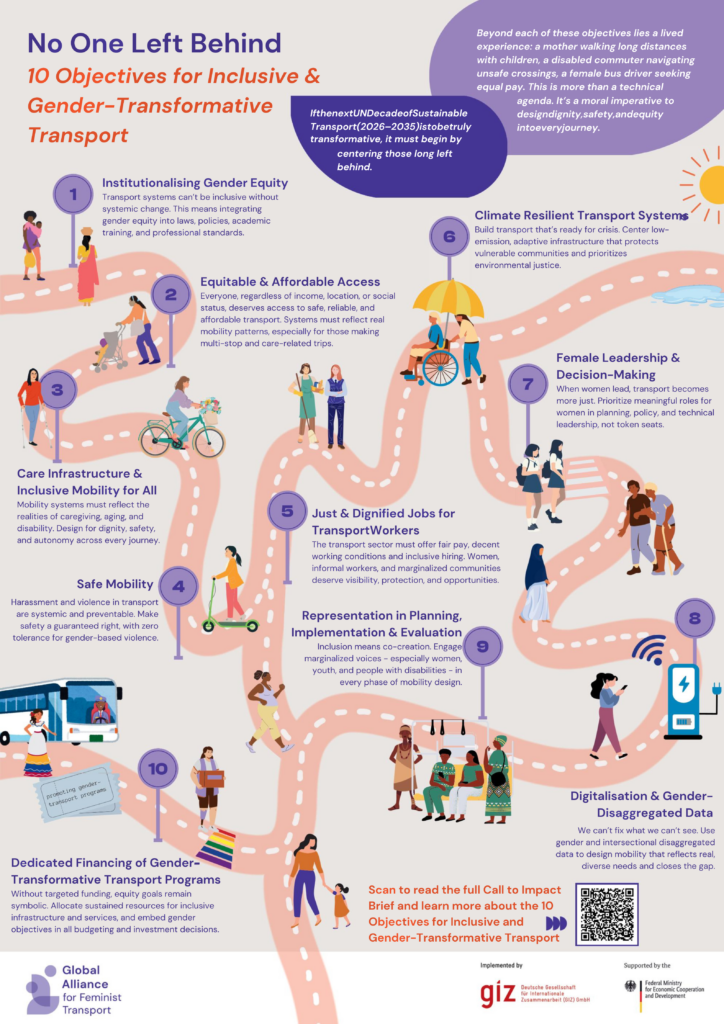
For a broader network of expertise and advocacy, visit the Global Alliance for Feminist Transport.
Transport systems are not gender-neutral. Women and men experience mobility differently — in how they travel, how safe they feel, and how much access they have to jobs and services. Women tend to make more complex, multi-stop journeys to balance paid work, caregiving, and daily errands, yet transport infrastructure and planning have historically been designed around a single male commuter model. At the same time, the sector’s workforce remains heavily male-dominated, with women underrepresented across driving, engineering, and leadership roles alike. The result is a system that falls short for a large share of its users.
In the process of decarbonising transport, gender equity must be built into the transition from the start. This means designing inclusive and safe public spaces, closing persistent gaps in women’s employment and leadership within the sector, and ensuring that the shift to new technologies — from electric vehicles to digital mobility platforms — opens rather than forecloses opportunities for women. A transport transition that leaves half the population behind is not a just one.
For a broader network of expertise and advocacy, visit the Global Alliance for Feminist Transport.
Transport systems are not gender-neutral. Women and men experience mobility differently — in how they travel, how safe they feel, and how much access they have to jobs and services. Women tend to make more complex, multi-stop journeys to balance paid work, caregiving, and daily errands, yet transport infrastructure and planning have historically been designed around a single male commuter model. At the same time, the sector’s workforce remains heavily male-dominated, with women underrepresented across driving, engineering, and leadership roles alike. The result is a system that falls short for a large share of its users.
In the process of decarbonising transport, gender equity must be built into the transition from the start. This means designing inclusive and safe public spaces, closing persistent gaps in women’s employment and leadership within the sector, and ensuring that the shift to new technologies — from electric vehicles to digital mobility platforms — opens rather than forecloses opportunities for women. A transport transition that leaves half the population behind is not a just one.
For a broader network of expertise and advocacy, visit the Global Alliance for Feminist Transport.