Freight and logistics form the backbone of India’s economy, yet they remain one of the least examined parts of the transport system from a workforce and inclusion perspective. While policy discussions increasingly focus on reducing emissions from freight, particularly from road-based transport, the social and labour dimensions of this transition receive far less attention. As India moves towards low-emission freight systems, this imbalance risks shaping a cleaner sector that continues to exclude large sections of the workforce, especially women.
Freight in India is dominated by road transport and characterised by long operating hours, dispersed workplaces, and physically and socially demanding conditions. Historically, this has shaped the sector as male-dominated, with limited entry points for women across driving, operations, technical, and leadership roles. These patterns persist not because of a lack of capability, but because the sector has evolved around assumptions that freight work is inherently unsuitable for women.
In urban logistics and last-mile delivery, where technology-enabled platforms have rapidly expanded employment opportunities, similar dynamics are visible. While these models lower some barriers to entry, women continue to face structural disadvantages. Safety concerns restrict mobility and working hours, particularly during evenings. The absence of clean sanitation facilities, safe resting spaces, and predictable work schedules directly affects participation and retention. In practice, this often translates into fewer earning opportunities and greater income instability for women compared to their male counterparts.
Skills and career progression present another critical challenge. Freight and logistics rely heavily on informal learning and experience-based advancement. Women typically have fewer opportunities to enter these pathways, and limited access to structured training that would enable movement into supervisory, technical, or managerial roles. As a result, women remain underrepresented not only in frontline operations but also in decision-making positions that shape how the sector evolves.
At the same time, the freight sector is undergoing significant structural change. Decarbonisation efforts, through electrification of vehicles, improved logistics efficiency, and digitalisation of operations, are altering how freight systems function. These shifts are changing job profiles across the value chain. Beyond driving, there is growing demand for roles in fleet management, charging operations, vehicle maintenance, data analysis, planning, compliance, and manufacturing. Many of these roles are less physically demanding and more skills-intensive, offering a potential pathway to broaden workforce participation.
However, these opportunities will not automatically translate into inclusion. Without intentional design, the low-carbon transition risks reinforcing existing inequalities under a new technological framework. Cleaner vehicles do not resolve safety challenges on their own. Digital platforms do not address skill gaps or weak labour protections. Infrastructure investments that overlook workforce needs, such as the location of charging stations or logistics hubs, can unintentionally create new barriers rather than remove existing ones.
A more inclusive freight transition requires a systems approach. Gender considerations need to be integrated into freight planning, decarbonisation strategies, and urban logistics design from the outset. Skill development programmes must align with emerging green freight roles and actively support women’s entry and progression. Workplace and public infrastructure, sanitation, rest facilities, safe access routes, and well-designed operational spaces, must be treated as core enablers of participation, not secondary concerns.
Data also plays a foundational role. Limited visibility on workforce composition, working conditions, and career pathways in freight makes it difficult to design effective interventions or track progress. Strengthening data collection, particularly gender-disaggregated data across freight and logistics segments, is essential for informed policy decisions and accountability.
Industry leadership is equally important. Employers that invest in inclusive hiring practices, redesign work environments, and support retention through training and safe working conditions can shift long-standing norms. These actions are not only socially responsible but also strategically sound. A more diverse workforce strengthens resilience, improves adaptability, and supports the sector’s ability to respond to technological and market changes.
Decarbonising freight is often framed as a technical and environmental challenge. In reality, it is also a moment of structural transformation. The choices made now, about infrastructure, skills, and workforce inclusion, will shape the freight sector for decades. Aligning climate ambition with gender equity is not an additional burden on the transition; it is a way to ensure that the transition delivers durable, equitable, and system-wide benefits.
This article draws on findings from the publication Gender Equity in Decarbonising Freight and Logistics Sectors in India: Brief Needs Assessment, which provides evidence-based insights into barriers and opportunities for women’s participation in India’s low-carbon freight transition.
A low-emission freight future that expands opportunities rather than narrows them will be better equipped to meet India’s economic, environmental, and social goals. Bringing gender equity into the centre of freight decarbonisation is not a peripheral concern, it is integral to building a transport system that is both sustainable and fit for the future.
NDC Transport Initiative for Asia (NDC-TIA) is part of the International Climate Initiative (IKI). The German Federal Ministry for Economic Affairs and Climate Action (BMWK) supports this initiative on the basis of a decision adopted by the German Bundestag. It supports China, India, and Viet Nam as well as regional and global decarbonisation strategies to increase the ambition around low-carbon transport.
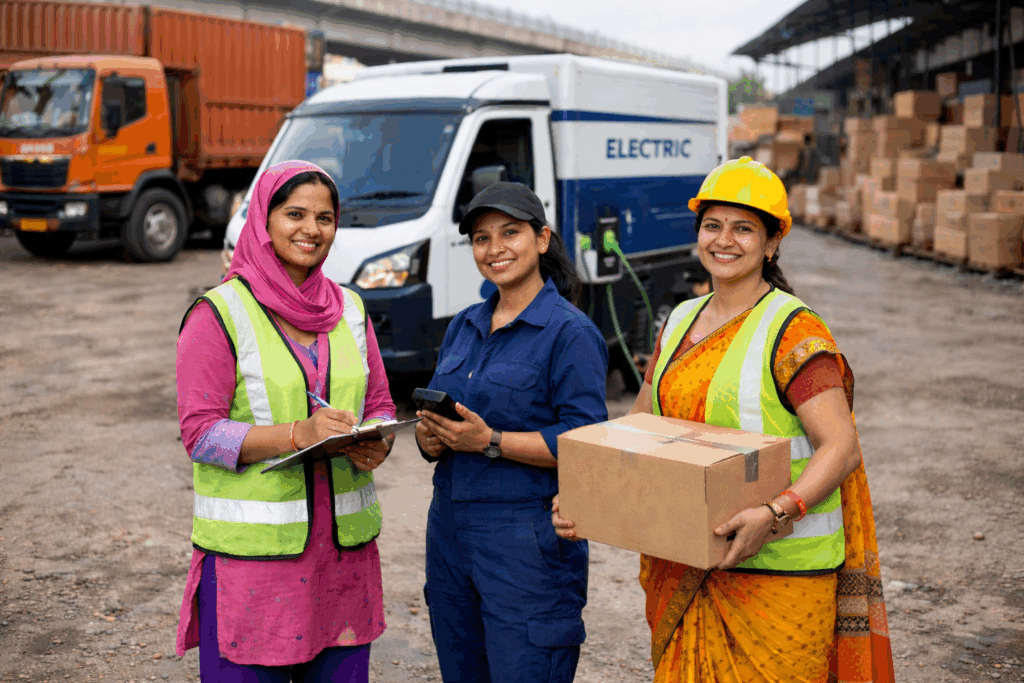
This image is AI-generated and used for illustrative purposes only.

Suraj Suresh Kanojia
suraj.kanojia@giz.de
Visit profile