
Ten years ago, many still doubted whether transport could be decarbonised at all. Today, electric buses, trucks and boats are running across the Global South, and in many markets, they already cost less to operate than their diesel equivalents. Yet, commitments are not turning into results fast enough.
Transport energy demand is still rising, national climate plans show growing ambition for transport but little planning for implementation1, and in Africa fewer than 10 percent of planned infrastructure projects reach financial close.
Two developments make closing this gap more urgent. The disruption to energy flows through the Strait of Hormuz showed how exposed oil-importing economies are, turning clean transport into a question of energy security, costs and jobs as much as climate. At the same time, budgets for international cooperation are shrinking. How partners work together, and what they can deliver with less, has become the central question for the decade ahead. It was also the guiding question of Transport and Climate Change Week 2026, held under the motto “Partnering for Action: Global Alliances and Opportunities for Decarbonising Transport”:
Decarbonising transport is not some sort of detour from energy security. It’s how we achieve our energy security.
Carly Gilbert-Patrick, Secretary-General, International Partnership on Sustainable Low Carbon Transport (SLOCAT)
Across 16 sessions, partners showed what partnering for action looks like in practice, and three conditions for turning commitments into results stood out.
The first is trust. Funders and implementers called for strengthening existing partnerships instead of launching new ones, and for designing change with the people who already run transport systems. In Pereira, Colombia, the Megabús system brought traditional bus companies in as feeder operators and now covers its operating costs from fares alone.
Better cooperation means we stop expecting trust to build in a project cycle and we build on existing long-term partnerships.
Eléonore François-Jacobs, Deputy Coordinator & Partnerships Manager, MobiliseYourCity Partnership
The second is shared evidence. Data makes commitments trackable and fundable, and it decides who is counted. In Chile, open data on charging and vehicle efficiency allows independent monitoring of national targets, and in Antipolo in the Philippines, 1,059 volunteers collected the data for the city’s sustainable urban mobility plan. Data also decides whose journeys are planned for. Transport is still designed mainly around the peak-hour commute, while many women make shorter, multi-stop trips to care for children and relatives. A Women Mobilize Women study found that 51 percent of women surveyed in Lagos travel for childcare or school runs, compared with 9 percent in Gauteng2 . Without that evidence, these journeys remain invisible to planners.
If you’re missing from the data, the system won’t be designed or managed for you.
Alfie Alsop, Infrastructure Adviser, UK Foreign, Commonwealth and Development Office (FCDO)
The third is certainty for investors. For electric trucks, speakers showed that stable policy, road toll exemptions and joint purchasing give fleet owners and banks the confidence to invest. For buses, 20 cities in the TUMI E-Bus Mission have committed to more than 100,000 electric vehicles, and for infrastructure, development banks called for investment pipelines built with partners from the start. Non-profit technological research is crucial to integrate innovation towards electrification of fleets.
Better cooperation means we stop working in parallel and start building the investment pipeline together.
Marco Yamaguchi, Division Manager, Transport and Logistics, African Development Bank
These findings feed directly into the years ahead. With the UN Decade of Sustainable Transportunder way since January, UNECE called for greater alignment between finance, policy, technology and implementation instead of new initiatives. The African Union Commission set out its ambition, through its new continental framework for electric mobility, for Africa not only to take part in the transition but to shape it. At COP31 in Antalya, the eleven countries of the Global Transport Effort will present their first report tracking transport energy demand and renewables, and BMUKN will bring the lessons of the week into the negotiations.
Knowing what works is not the same as knowing how to make it work.
Frederik Strompen, Project Lead, Mobilize Net Zero, GIZ
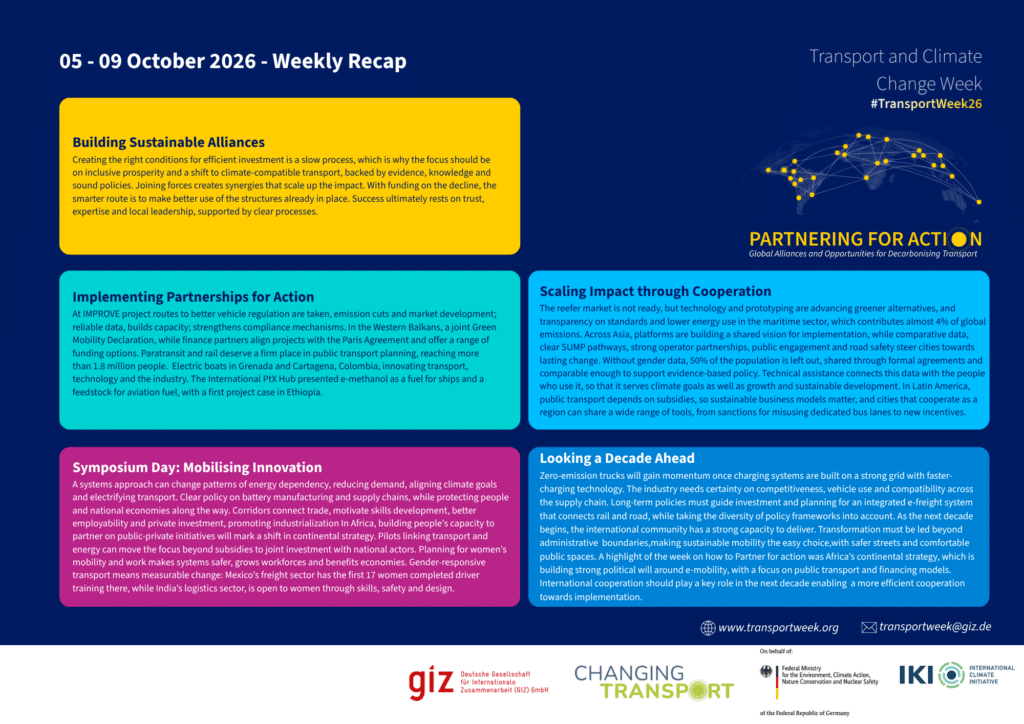
What gives these conclusions weight is who reached them. More than 900 people from 34 countries registered for the ninth edition, held online from 5 to 9 October 2026. Across 16 sessions, the week counted for 740 attendances, and 81 speakers took part, from ministries and city halls to bus operators, development banks and start-ups across Africa, Asia, Latin America and the Caribbean, and Europe.
Over the past nine years, the Transport and Climate Change Week has become the forum where countries can share how to set targets and how to turn them into action.
Birgit Schwenk, Head of Sub-Department for Policy Issues, Economic and Social Affairs, Sustainability and Transport, Federal Ministry for the Environment, Climate Action, Nature Conservation and Nuclear Safety (BMUKN)
What makes this exchange useful is that it runs between regions, not only within them. This year, participants from Africa asked how India’s integrated infrastructure planning could inform corridors under the African Continental Free Trade Area. The city of Nakhon Ratchasima offered to share its electric school shuttle model with other cities in Asia, and Cartagena drew on lessons from Grenada’s electric boats for its own water transport plans. With budgets under pressure, this kind of peer learning means partners do not have to pilot every solution in every country.
This year, a new interactive partnership map connected over 100 experts by country and expertise, while the first Transport Week’s Digital Exhibition opened the conversation to artists, with photography from Brazil, paintings from India, poetry from Thailand, illustrated stories from Uganda and a documentary on the daily commutes of domestic workers in Latin America.
Ten years ago, the question was whether transport could be decarbonised. Today, it is how quickly we can make clean, safe and affordable mobility part of everyone’s daily life. As Transport and Climate Change Week approaches its tenth edition, its community carries that question forward by partnering for action, convinced that what works in one place can light the way for many others.
The Mobilize Net-Zero project team is organising the Transport and Climate Change Week, alternating between a virtual and face-to-face format. The project is implemented by the Deutsche Gesellschaft für Internationale Zusammenarbeit (GIZ) GmbH and is funded through the International Climate Initiative (IKI) of the German Federal Ministry for Economic Affairs and Climate Action (BMWK).
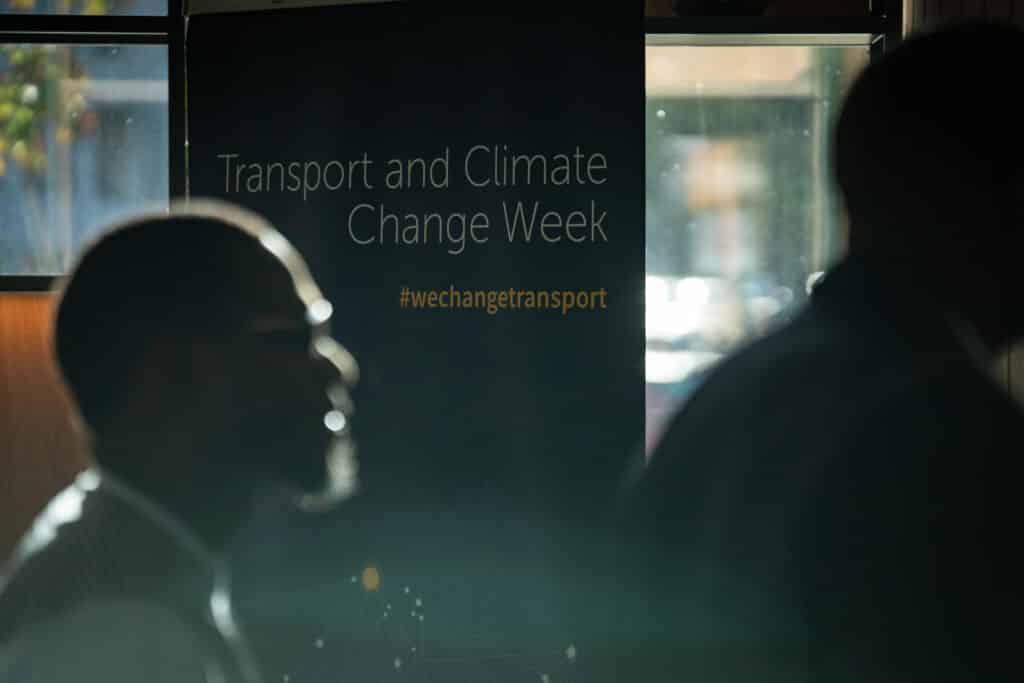
Over nine editions, Transport and Climate Change Week has brought together people working to change how the world moves. © GIZ/Thomas Ecke

Andrea Palma
andrea.palma@giz.de
Visit profile

Cristal Stefania Cedeño Tobanda
cristal.cedenotobanda@giz.de
Visit profile
You are currently viewing a placeholder content from reCAPTCHA. To access the actual content, click the button below. Please note that doing so will share data with third-party providers.
More Information