
Transport accounts for roughly 20% of global greenhouse gas emissions and remains one of the hardest sectors to decarbonise. For decades it has also been one of the least addressed in international climate policy, a gap that a growing coalition of countries is now determined to close.
The Ministerial Declaration Towards Resilient and Low-Emissions Transport Systems for People, Development and the Planet was launched at COP30 in Belém in November 2025 and signed by eleven countries: Chile, Colombia, Brazil, Costa Rica, Honduras, the Dominican Republic, Portugal, Spain, Norway, Slovenia, and Austria.
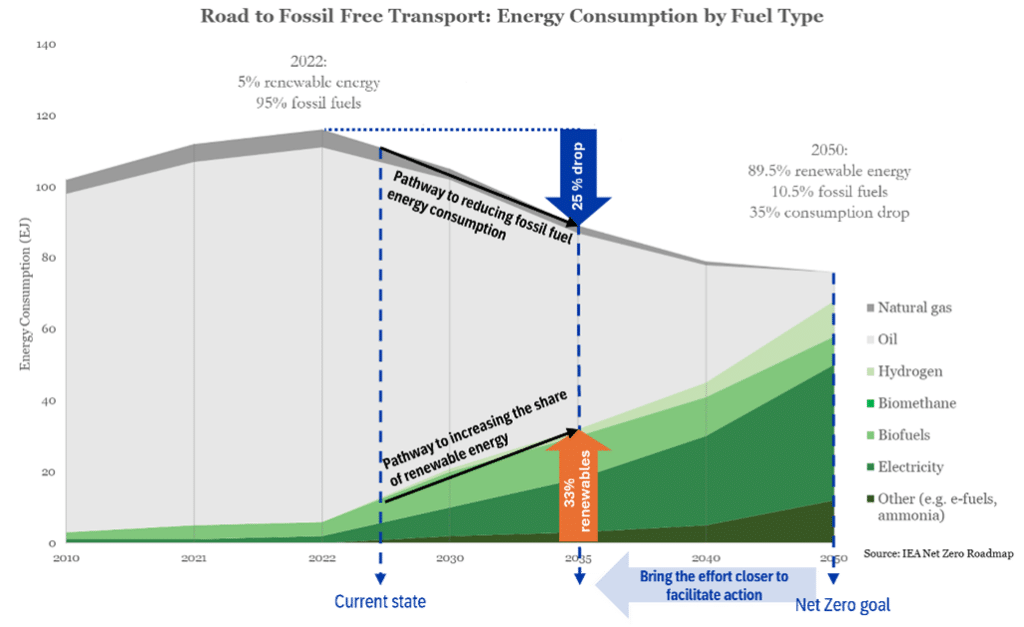
Its objective is clear: to achieve, at a global level, a 25% reduction in transport energy demand by 2035, with at least one third of that energy sourced from renewables and sustainable biofuels.
Six months later, at the annual ITF Summit in Leipzig, the coalition showed it was ready to move from commitment to action.
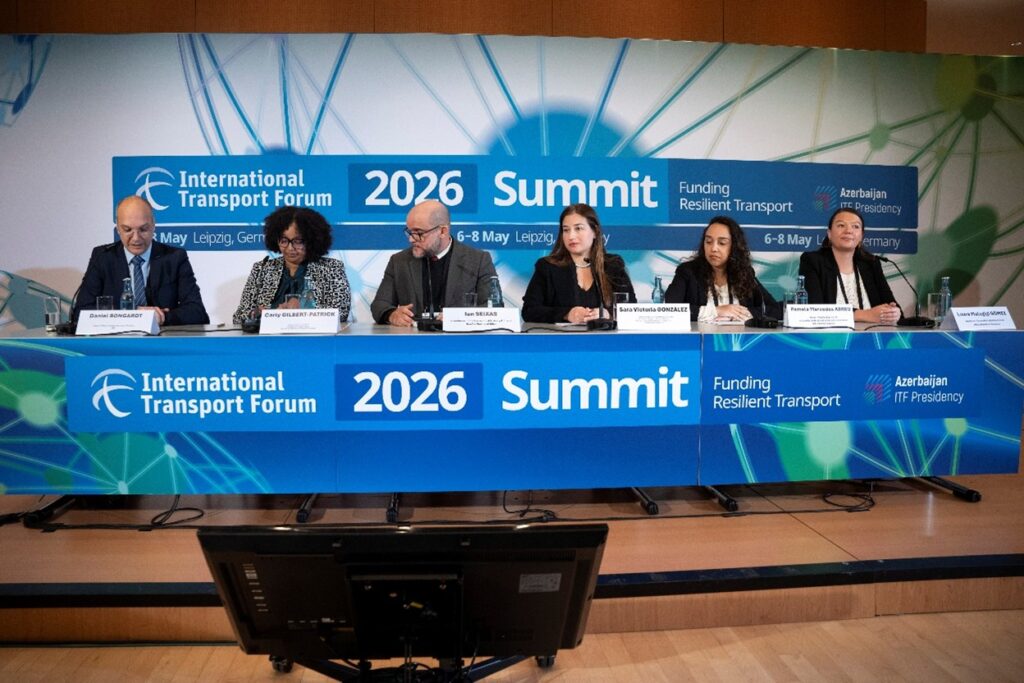
On 7 May 2026, signatory countries gathered for a press conference that marked the beginning of the Declaration’s implementation phase. The centrepiece was the Dominican Republic’s formal assumption of the coalition’s co-presidency, a move that reframed the initiative’s centre of gravity. As a small island developing state where transport is the second fastest growing source of greenhouse gas emissions, the Dominican Republic brought both urgency and credibility to the role. Sara González, Technical Director of the National Council for Climate Change and Carbon Market and COP Vice-President of the UNFCCC, was clear about what the co-presidency represents: not only climate leadership, but a shift in who gets to define solutions.
We are not only receiving the great international cooperation that we have been receiving for so long but also creating solutions ourselves.
Sara González, Technical Director, National Council for Climate Change and Carbon Market, Dominican Republic
That shift ran through every contribution at the press conference. Colombia’s representative noted that the alliance, led first by Chile and now by the Dominican Republic, “proves that the Global South can lead the transformation of transport towards cleaner, more resilient and more inclusive systems.” Brazil’s Ian Seixas emphasised multilateralism as non-negotiable: the Declaration, he argued, is only as strong as the number of countries willing to build it together, and Brazil’s role is to keep expanding that number at every COP. González herself closed with an open call to the Global North to take up a co-chair role in the coalition, particularly among countries that have already signed.
Taking on the co-presidency also means taking on the agenda. Pamela Abreu, Head of Mitigation at the Dominican Republic’s National Council for Climate Change, presented the coalition’s work plan for 2026 and 2027, built around four objectives:
The 2028 Global Stocktake is the coalition’s critical near-term milestone. The energy sector successfully embedded its targets in the first GST at COP28, and transport is now working to do the same. The coalition held its first in-person meeting the day after the Leipzig press conference, turning the work plan from an announcement into a working agenda.

Tracking progress is as important as setting targets. Alongside the Leipzig events, GIZ Changing Transport published Tracking Global Progress on Cleaner Transport, a methodological report proposing a rigorous framework to monitor the Declaration’s two core targets, using both final energy and useful energy accounting and drawing primarily on IEA World Energy Balances data. Its central finding: electrification is the make-or-break lever. Slower-than-expected progress on road and rail electrification would significantly undermine the 25% target, while accelerated electrification would deliver benefits well beyond it. The report calls for an annual global progress report each September, feeding directly into UNFCCC accountability processes.
Carly Gilbert Patrick, Secretary General of SLOCAT Partnership, representing over 100 organisations working at the intersection of climate, transport, and sustainable development, welcomed the framework as part of a broader push for the transport sector to speak with one coherent voice internationally. For SLOCAT, the Declaration already functions as a head start on the global goal for transport: a north star that any country can sign up to and find its own path toward.
A statement read on behalf of Ethiopia’s State Minister of Transport and Logistics brought one of the most striking contributions of the day. Ethiopia has become the first country in the world to ban the import of fossil fuel vehicles, has over 140,000 electric vehicles on its roads, runs an all-electric railway network, and is building an electric BRT system in Addis Ababa with 15 planned corridors, with 850 additional electric buses planned before COP32. The minister’s message was direct:
A resilient, low-emission transport system is not a luxury. It is the foundation of a secure, inclusive, and prosperous future.
Bareo Hassen, State Minister of Transport and Logistics, Ethiopia (statement read at the press conference)
The Minister also highlighted the importance of this Declaration and what it represents for the future of the transport sector. Ethiopia’s recognition for the Declaration is particularly significant, especially considering that COP32 will be held in Addis Ababa and is expected to become the “Transport COP.”
By committing to reduce transport energy demand by 25% by 2035, we are sending a clear signal: we intend to phase out fossil fuels in a planned and equitable way. Ethiopia strongly supports the development of a Global Goal for Transport by 2028, closely aligned with the UN Decade for Sustainable Transport.
The Leipzig press conference took place weeks after the first International Conference on Transitioning Away from Fossil Fuels (TAFF), held in Santa Marta, Colombia, in April 2026. Where TAFF addressed the supply side of the fossil fuel transition, reducing production of coal, oil, and gas, the Ministerial Declaration works the demand side: cutting how much energy transport consumes and cleaning up what remains. Together they represent complementary pillars of the same shift in international climate policy, both oriented toward the 2028 Global Stocktake and the COP31 and COP32 milestones.
Both processes share the same logic: coalitions of countries willing to move faster, building momentum and inviting others in, while feeding into the UNFCCC rather than replacing it. The transport coalition’s message from Leipzig was that momentum is no longer enough: the plan and the leadership already exist, what will come next is delivery.
The Mobilize Net-Zero project is implemented by the Deutsche Gesellschaft für Internationale Zusammenarbeit (GIZ) GmbH and is funded through the International Climate Initiative (IKI) of the German Federal Ministry for the Environment, Climate Action, Nature Conservation and Nuclear Safety (BMUKN).
Press Conference "From Declaration to Action: Putting Transport at the Heart of Climate Policy" at the ITF Summit © International Transport Forum

Cristal Stefania Cedeño Tobanda
cristal.cedenotobanda@giz.de
Visit profile

Natalia Meza
natalia.meza@giz.de
Visit profile
You are currently viewing a placeholder content from reCAPTCHA. To access the actual content, click the button below. Please note that doing so will share data with third-party providers.
More Information