Transport plays a central role in achieving national and global climate targets. This is reflected in the growing number of transport-related commitments in countries’ Nationally Determined Contributions (NDC). However, transport commitments in NDCs are usually embedded in narrative policy text. This makes them difficult to analyse, compare and use for decision-making. How can this issue be solved, for example to better understand the diverse approaches of countries to integrate electric vehicles (EVs) in their transport systems?
Electrification has become a central pillar of transport decarbonisation strategies worldwide. With 76 percent of the submitted third-generation NDCs including electrification, it is the most frequently referenced transport measure.
In their effort to reduce transport emissions, governments, development partners and sectoral actors seek clarity on where countries stand, how ambitious their commitments are, and how their approaches align with long-term mitigation pathways. To answer these questions structured and reusable data is key. Turning narrative NDC commitments into open, structured transport data is a prerequisite for evidence-based policy analysis. The shift from isolated reporting to systematic evidence enables comparison, learning and targeted policy discussions. Together with SLOCAT, the GIZ project Mobilize Net-Zero developed the NDC Transport Tracker to facilitate this shift. The partners then collaborated with Agora Verkehrswende and turned the idea into practice by creating the EV NDC World Map.
The NDC Transport Tracker addresses the critical information gap on how countries integrate the transport sector into their climate commitments. Policymakers and researchers lacked a consistent evidence base to assess progress and identify opportunities for stronger transport action.
NDCs are political texts, not datasets. The NDC Transport Tracker extracts and structures transport-related information from these documents. It translates qualitative commitments into comparable transport variables, while keeping a direct link to the original source text. This ensures transparency and traceability.
Instead of producing a single interpretation of ambition, the NDC Tracker serves as an enabling infrastructure. It captures a wide range of transport variables, including electrification, modal shift, fuel transition, efficiency, and governance measures. The compiled data is then provided in an open and structured way, so that others can reuse it for their own analysis.
Openness is a core principle of the NDC Transport Tracker. The data can be reused, reviewed and enriched by different actors. However, providing data openly is not enough. To create impact, data must also be structured, documented and interoperable.
For this reason, the full dataset with more than 640 analysed documents is available through the Transport Data Commons Portal. This infrastructure supports access, reuse, and integration with other open transport datasets. It follows FAIR principles and a collaborative approach to data governance.
When these conditions are met, open data becomes a multiplier by reducing duplicated analytical effort, enabling thematic deep dives and supporting consistent comparison across countries and time. The Tracker is built to serve this multiplier effect. It is a foundation, not an endpoint.
As a policy think tank focused on decarbonising the transport system, Agora Verkehrswende (German for transport transformation) had the goal to systematically evaluate the global ambition for electric vehicles (EVs) as stated in the primary instruments of international climate policy: the Nationally Determined Contributions. Moving beyond anecdotal evidence allows for quantified, comparable analysis to understand how countries use these decarbonisation strategies to meet their Paris Agreement commitments.
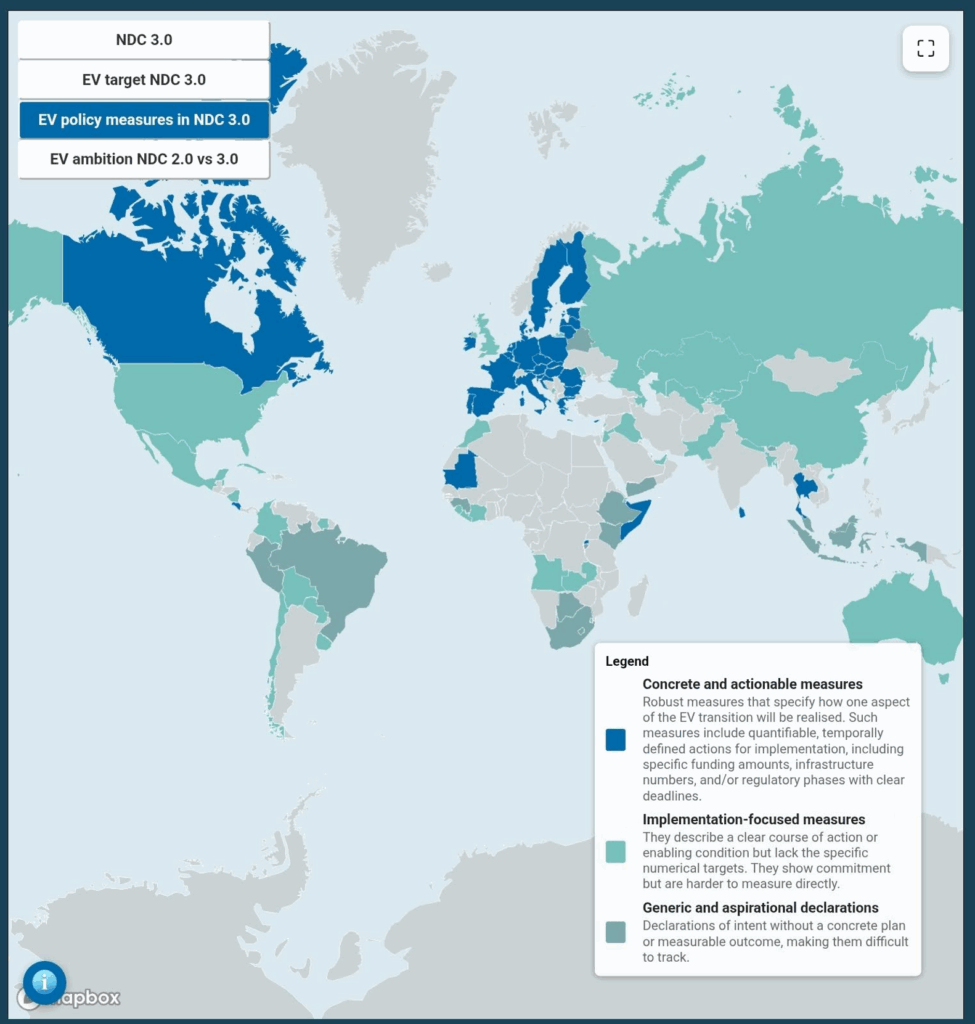
The pre-processed dataset was instrumental to this work. By providing extracted and classified transport text from every NDC, the NDC Transport Tracker eliminates the need for manual data compilation, allowing analysts to focus on interpreting the information and generating policy insights. Using this foundation, Agora developed the EV NDC World Map, a public tool that visualises and tracks national electric mobility commitments directly from the source documents.
The resulting analysis (of NDCs submitted up to 15 December 2025) delivers clear findings: 104 countries have now committed to support electric mobility in their NDCs. Within this group, 66 parties (including the 27 EU Member States under one united submission) have set specific EV expansion targets, marking a record level of formal ambition. However, the data also exposes critical gaps. The countries with specific targets account for just 34 percent of global transport-sector GHG emissions, highlighting a major shortfall in commitment from some of the world’s largest emitters. Furthermore, the analysis identifies a near-universal implementation risk: national vehicle adoption goals are almost never paired with explicit, quantified, and funded targets for deploying public charging networks. This finding reveals a potentially decisive bottleneck for the entire transition.
The case of the EV NDC World Map illustrates the power of the NDC Transport Tracker as a public tool. It enabled a dedicated policy organisation to transform a broad question into targeted, actionable insights—identifying both the growing momentum for electric mobility and the precise gaps in ambition and planning that must be closed to ensure its success. The collaboration between the NDC Transport Tracker and Agora Verkehrswende shows what is possible when open and structured transport data is taken seriously.
Analysing electrification efforts is one example of how the Tracker can be used. The same approach can support analysis of other transport priorities, such as public transport investment, freight decarbonisation, non-motorised transport, fuel transitions in shipping or aviation, and governance or financing frameworks. Different organisations can explore these themes in depth by using the Tracker as a shared starting point. When combined with other open datasets from institutions committed to FAIR principles, this approach supports complementary analysis rather than fragmented evidence.
As more actors build on a shared data foundation, transport climate discussions can move beyond fragmented reporting. They can become more targeted, comparable and data-driven. The real value of the NDC Transport Tracker lies not only in the data it provides, but in the questions it enables others to answer.
The NDC Transport Tracker is developed by GIZ Transport and the SLOCAT Partnership on Sustainable, Low Carbon Transport. It is part of the Mobilize Net Zero project that is implemented by the Deutsche Gesellschaft für Internationale Zusammenarbeit (GIZ) GmbH and is funded through the International Climate Initiative (IKI) of the German Federal Ministry for the Environment, Climate Action, Nature Conservation and Nuclear Safety (BMUKN).
The EV NDC World Map turns data from the NDC Transport Tracker into a visual that enables interaction and analysis. | © Agora Verkehrswende

Belén Vásquez
maria.vasquez1@giz.de
Visit profile

Linda Cáceres Leal
linda.caceres.leal@agora-verkehrswende.de
Visit profile