

This story is part of our #StoriesOfChange series, where we share how our colleagues and partners are making sustainable mobility real and changing lives along the way. Read more stories here.
In Santo Domingo, getting from the periphery to the city centre has long meant navigating a patchwork of conchos (informal shared taxis), crammed buses, and streets rarely designed for pedestrians. For millions of residents, particularly those without a car, daily mobility is a source of stress, risk, and exclusion. This is not a story unique to the Dominican capital: it plays out across cities in the Global South, where transport systems have grown around individual motorised vehicles while public and active modes have been left behind.
It is precisely this gap, the one between the mobility that cities need and the systems they have, that the MobiliseYourCity Partnership was created to address. Launched at COP21 in Paris in December 2015, the Partnership brings together implementing organisations (AFD, GIZ, CODATU, Cerema, ADEME, EBRD, KfW, and the Wuppertal Institute) with cities and national governments across the Global South, co-financed by the European Commission, France and Germany. Its founding premise is that lasting progress in sustainable mobility requires not only the right plans, but the institutional, financial and technical conditions to act on them.
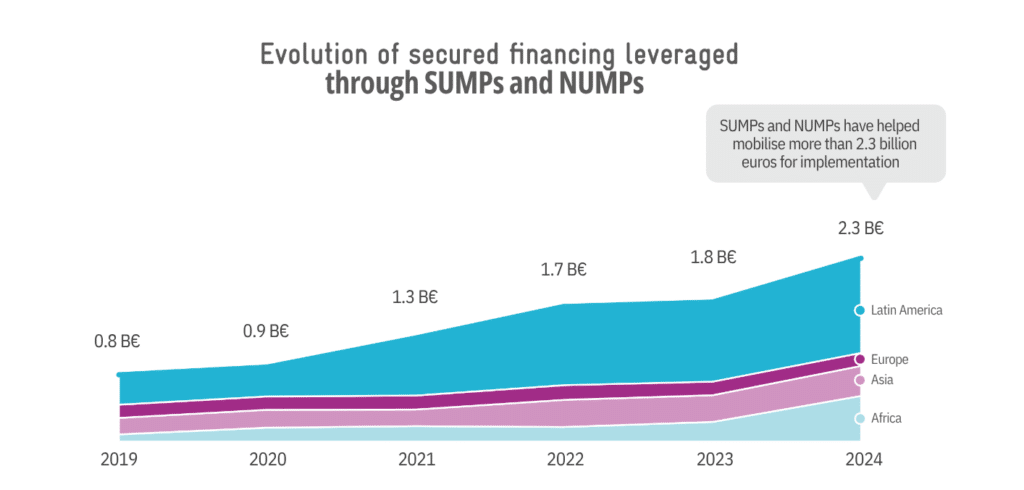
Ten years in, MobiliseYourCity has grown to more than 82 member cities across 39 countries, representing a combined population of over 155 million people. The Partnership has supported the preparation of 32 Sustainable Urban Mobility Plans (SUMPs) and 9 National Urban Mobility Policies and Investment Programmes (NUMPs), mobilised €62.1 million in grants, and leveraged €2.3 billion in financing for implementation. From COP21 in Paris to COP30 in Belém, the Partnership has traced a decade of growing ambition, and this anniversary is an opportunity to reflect on what that journey has made possible, and what still lies ahead.
Across much of the Global South, the central challenge in urban mobility has long been the difficulty of producing, and then acting on, adequate plans. Cities are expanding rapidly, travel demand is growing, and road-centric development patterns continue to generate mounting congestion, air pollution and exclusion.
Santo Domingo captures many of these dynamics in one place. With over 3.5 million inhabitants and a motorisation rate of 155 vehicles per 1,000 residents, the city’s transport system was shaped by decades of unregulated, uneven urbanisation. The result: vastly different service levels across municipalities, a stark contrast between the city centre and its periphery, and a formal public transport system reaching only 10% of the population. Conchos, informal shared taxis, account for 14% of all trips; the metro, just 9%.
Planning itself remains a significant constraint in many member city contexts. Cities frequently lack the methodologies, data systems, institutional capacity, and participatory processes needed to develop integrated mobility strategies. The distinction between a road-centric infrastructure plan and a people-centred mobility plan, one that accounts for active travel, public transport, access, gender and climate, is not widely embedded in planning practice. At the national level, coherent urban mobility policies and investment frameworks are still relatively rare, even as Nationally Determined Contributions (NDC) commitments demand them.
Project readiness compounds this challenge. Even where strategies identify priority interventions, translating them into proposals that can attract financing requires analytical work, feasibility studies, preliminary design, stakeholder engagement and safeguards. This is technically demanding work that most local and national transport authorities are not resourced to manage independently. In Santo Domingo, INTRANT, the national transport authority, has faced precisely this constraint: high demand, limited staff, and a shortage of locally trained urban mobility experts. Designing viable funding frameworks — clarifying who pays for what across national budgets, municipal revenues, user fares, and international finance — remains a persistent gap in most member contexts.
Governance is a further structural challenge. Urban mobility crosses jurisdictional boundaries between municipalities, metropolitan authorities and national ministries, requiring coordination across mandates that rarely align naturally. Where institutional arrangements are informal or contested, sustaining multi-year reform programmes is difficult, and technical teams are often asked to deliver complex changes without the authority, staffing or processes required.
Compounding these governance gaps is the prevalence of informal and paratransit services. In many cities across the Global South, paratransit operators — minibuses, motorcycle taxis, and other informal providers — account for the majority of motorised trips. This sector is often invisible to planners and policymakers: unregistered, unmapped, and excluded from official statistics. For transport planning to be credible, and for emissions accounting to be accurate, paratransit must first be identified and incorporated into the analytical baseline. MobiliseYourCity has developed specific guidance on integrating paratransit data into greenhouse gas emissions calculations, a necessary step before meaningful decarbonisation pathways can be designed.
These constraints reinforce each other. Weak planning undermines the credibility of investment cases; insufficient project preparation keeps priorities at the level of intent; fragmented governance makes it hard to sustain momentum across electoral cycles. For residents, the daily consequences are tangible: unreliable services, unsafe streets, and persistent exclusion from mobility, with low-income households bearing the heaviest burden.

MobiliseYourCity’s response to this landscape is to accompany cities and countries across the full chain that connects planning ambition to delivery, combining methodological development, technical assistance, capacity building, knowledge exchange and convening. Rather than approaching mobility reform as a set of discrete projects, the Partnership works at both city and national levels, recognising that durable progress often depends on aligning the two.
The Partnership’s core methodological contribution, SUMPs and NUMPs, reflects a deliberate shift from infrastructure-led planning to an integrated, people-centred approach grounded in the avoid-shift-improve framework. As of 2025, 20 SUMPs and 6 NUMPs have been completed, with €62.1 million in grants mobilised to support this work.
Beyond planning, MobiliseYourCity offers targeted implementation support in areas where local financing capacity is structurally limited: walking and cycling infrastructure, paratransit reform, and policy and regulatory changes. This support is deliberately practical, piloting interventions that generate operational learning, build institutional confidence, and make progress visible to residents and decision-makers as broader reform processes unfold.
In Santo Domingo, this logic has translated into concrete results. The city’s SUMP, adopted in 2019 under the Partnership’s support, set an ambitious vision: expand formal public transport from 10% to 43% of the population, increase the public transport modal share from 36% to 44%, and reduce transport-related greenhouse gas emissions by 20% by 2030. The plan’s total investment requirement stands at USD 2.6 billion, of which USD 1.25 billion is already financed.
Building on this foundation, the AIPMUS project (€10 million, EU Caribbean Investment Facility, implemented by AFD with CODATU and Expertise France) accompanied the transition from planning to implementation. Its two phases — 2021–2024 focused on capacity building and transport modelling, 2024–2026 on technical studies and infrastructure design — have produced early, tangible results: 900 conchos formalised into structured bus operations, with 141 buses now running along three prioritised corridors. Cycling infrastructure has advanced too, with 10 km of cycle lanes built and national cycling-lane guidelines published and adopted. Studies are under way for a bus rapid transit corridor, a bike-sharing system, a fare policy, and an intermodal hub connecting the metro, cable car and intercity buses.
This experience in Santo Domingo mirrors the logic the Partnership has applied across its portfolio. In Yaoundé, diagnostic foundations informed concrete delivery pathways linking major public transport improvements with safety and inclusion pilots. In Dakar, a citywide strategy was reinforced through measures embedding walking and cycling within broader investment dynamics. Across these contexts, sustained engagement has served to reduce the gap between plan adoption and the first concrete steps of implementation.
Knowledge exchange and communications complement this direct support by making applied experience transferable. The Partnership develops, tests and scales methodologies and tools, including an Emissions Calculator now used in 26 cities and seven countries, and translates field experience into guidance practitioners can apply across different institutional and regulatory contexts.
The most meaningful results of a partnership model like MobiliseYourCity’s are not limited to the number of plans produced or activities delivered, even if these matter as indicators of reach and engagement. What the Partnership is ultimately working toward is the increased feasibility of implementation: stronger institutions, clearer delivery pathways, and a more credible pipeline from concept to execution. Ten years in, the Global Monitor 2025 offers a first systematic snapshot of what sustained engagement has enabled.
At the portfolio level, the numbers reflect genuine scale. The Partnership reports €2.3 billion leveraged for implementation across completed SUMPs and NUMPs, against €27.8 billion in identified investment needs. Successful implementation of SUMPs is projected to reduce annual GHG emissions by an average of 16% compared to business as usual, with six cities on track to achieve a combined reduction of 3.79 Mt CO₂ by 2030.
In just nine cities where MobiliseYourCity has been active, including Santo Domingo, plans call for 3 metro lines, 7 BRT corridors, 7 bus corridors, 6 tram lines, a cable car, and more than 34 transport hubs, stations and depots to be financed through mobilised investments. In Santo Domingo alone, USD 600,000 has been secured to improve public transport access for persons with disabilities, and a further USD 600,000 will fund a tariff subsidy study for the most vulnerable populations.
At the institutional level, the shift is harder to measure but equally significant. In cities and countries where MobiliseYourCity has operated over multiple years, transport authorities and national programme managers are increasingly equipped with data systems, coordination routines and project-preparation capacity that can sustain reform beyond individual project cycles. In Santo Domingo, INTRANT’s growing technical expertise, built through the SUMP and AIPMUS process, now enables it to lead project development with reduced dependence on external consultants.
The work does not stop here. In Santo Domingo, the FIMUS programme, a new phase of institutional strengthening co-designed by CODATU and Expertise France, is now taking shape, building on the foundation laid by AIPMUS. For MobiliseYourCity, this new phase represents an opportunity to strengthen synergies, build on ongoing experiences, and deepen knowledge sharing on key sustainable mobility issues, including through joint webinars and capacity-building exchanges with CODATU.
More broadly, the convening effect of the Partnership has compounded over time. A network that began with a handful of cities has grown to more than 82 member cities across 39 countries, with over 100 institutional partners. The addition in 2025 of cities including Jakarta, Istanbul and Cajamarca, alongside the Movamos Region network, reflects continued demand and a broadening geography of practice.
The constraints that motivated MobiliseYourCity’s creation — weak planning capacity, insufficient project preparation, fragmented governance, underserved communities — remain live in most member city contexts. But the Partnership enters its second decade from a stronger base: more cities, more institutional partners, more tested methodologies, and a growing body of evidence that sustainable urban mobility transitions are not only necessary, but achievable. From Paris to Belém, the journey continues.
MobiliseYourCity is a global Partnership supporting cities and national governments in the Global South to plan and implement sustainable urban mobility. Launched at COP21 in Paris in 2015, it brings together implementing organisations — AFD, GIZ, CODATU, Cerema, ADEME, EBRD, KfW, and the Wuppertal Institute — across more than 82 member cities in 39 countries. The Partnership is co-financed by the European Commission, the French Government, and the German Federal Ministry for Economic Cooperation and Development (BMZ).
Want to stay up to date on sustainable urban mobility? Subscribe to the MobiliseYourCity newsletter for the latest news and updates from cities around the world.
Public transport in action: a passenger holds on during their daily commute. © Emmanuel Ikwuegbu


Emma Lyons
emma.lyons@mobiliseyourcity.net
You are currently viewing a placeholder content from reCAPTCHA. To access the actual content, click the button below. Please note that doing so will share data with third-party providers.
More Information