This story is part of our #StoriesOfChange series, where we share how our colleagues and partners are making sustainable mobility real and changing lives along the way. Read more stories here.
Every morning in Rumiñahui, Ecuador, hundreds of children make their way to school on streets designed mainly for cars. Narrow sidewalks, fast-moving traffic, unsafe crossings, and unregulated parking shape these daily journeys, often leaving children, caregivers and older residents feeling exposed and unsafe. What should be a short walk to school can become a stressful experience, discouraging independent mobility and limiting how people use public space.
For decades, mobility patterns in Rumiñahui have been shaped largely by private motorised transport. Streets have prioritised vehicle flow over people, leaving little room for safe walking, cycling, social interaction, or play. As a result, public space has struggled to function as a shared place that supports children’s independence, community life, and everyday safety. Instead, vulnerable road users have often felt marginalised and discouraged from moving freely.
This local reality stands in contrast to Ecuador’s growing national ambitions. In 2023, the country launched its National Urban Mobility Policy (NUMP), signalling a strong commitment to sustainable and inclusive mobility. Yet, in Rumiñahui the gap between policy and lived experience remained visible. Regulations alone had not yet translated into safer streets, especially around schools. Faced with this disconnect, the municipality set out to test a different approach: one that combined technical expertise with community participation, and small, low-cost interventions with long-term ambition.
Public spaces are for families, for people, so that our children and future generations can live and move safely.
Fabián Iza, Mayor of Rumiñahui
The result was a tactical urbanism pilot designed to reimagine a high-risk school area, and, in doing so, to demonstrate how streets can be reclaimed for people.
Several factors intensified the urgency to act. Between 2022 and 2024, the city registered 88 traffic accidents, many of them occurring near schools and at high-conflict intersections. Excessive vehicle speeds, limited traffic-calming measures, and poorly designed crossings created daily risks, particularly for children and adolescents.
Beyond physical safety, there was a growing sense of insecurity. Women and girls often experienced public space through fear and caution, while caregivers pushing strollers or accompanying children to school struggled with barriers such as narrow sidewalks, missing ramps, unregulated parking, and unsafe crossings. These conditions limited independent movement and reduced confidence in the street as a shared space.
Although national policies increasingly recognise child-friendly and gender-responsive mobility, these principles had not yet been embedded in local street design. The challenge was not a lack of vision, but the absence of practical tools and processes to translate policy goals into tangible change on the ground.
In response, the Municipality of Rumiñahui implemented a tactical urbanism pilot near key educational and community facilities, with support of the Promoting Green Mobility in Mid-sized Cities in Ecuador (MoVer Ciudades) project. The project is co-funded by the German Federal Ministry for Economic Cooperation and Development (BMZ) and the European Union and implemented by GIZ.
The pilot was built on close coordination between the municipal mobility department, the private high school Madre de la Divina Gracia, neighbourhood organisations, technical partners, private companies, and residents. Rather than imposing a fixed design, the process focused on co-creation and learning by doing.
Key steps included technical street observations to identify risk patterns, followed by participatory workshops with students, families, local businesses, and municipal staff. Children and teenagers were actively involved through playful methods, while adults used tools such as the reverse periscope, allowing them to experience the street from the height and perspective of a five-year-old child.
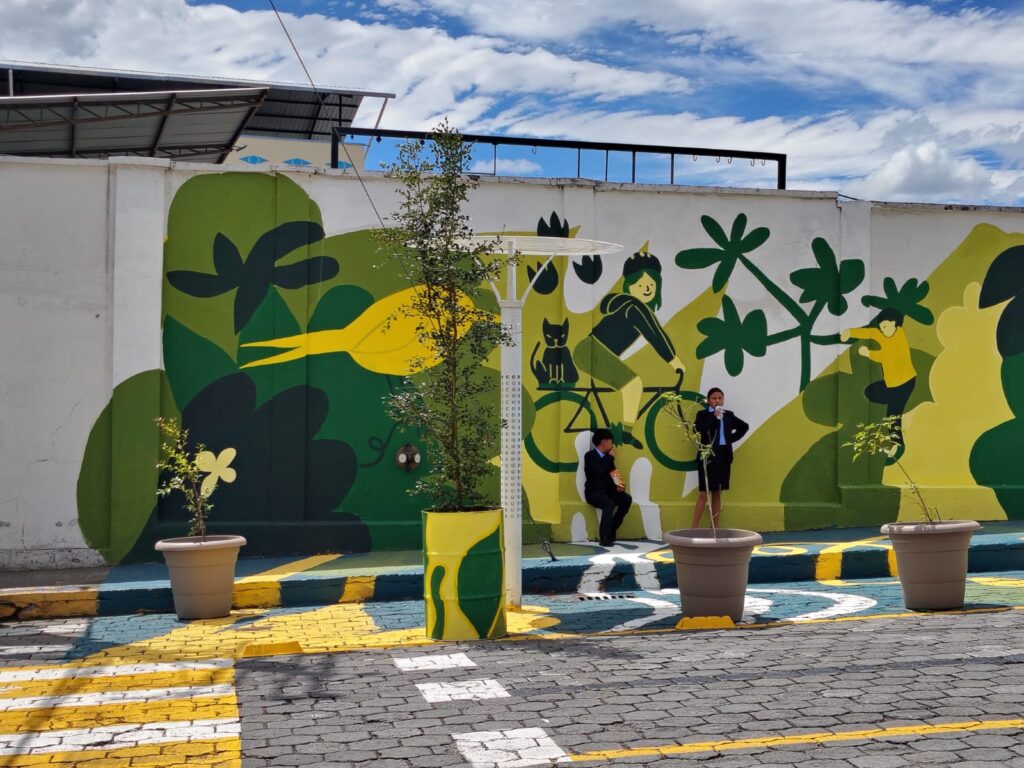
Based on this shared diagnosis, the pilot introduced temporary street interventions: expanded pedestrian areas, traffic-calming elements, painted crossings, signage, and protected school-access zones with a reduced speed limit of 20 km/h. A community workday, a minga, brought residents and authorities together to implement the changes collectively.
This project focuses on creating safe spaces to ensure the protection of children as they move to and from their school.
Marcelo Albán, Neighbourhood President

Local leaders and community members share how the pilot reshaped daily life and strengthened ownership of public space.
Following the installation, the transformation of the street environment was immediately visible. Vehicle speeds decreased, crossings became clearer, and pedestrians reclaimed space previously dominated by traffic. Children and families began to use the street more confidently, while residents reported feeling safer and more comfortable moving through the area.
Preliminary results showed improved pedestrian safety, increased use of public space by families and older residents, and a stronger perception of safety and comfort.
Beyond these indicators, the pilot produced something less measurable but equally important: a shared sense of ownership over public space. The experience also strengthened municipal capacity, providing a replicable methodology that can guide permanent street redesigns and inform future regulations. Most importantly, it showed that even small, low-cost interventions can trigger meaningful shifts when they are rooted in participation and trust.

The pilot directly benefited 617 students and their families, but its impact extended broadly to nearby residents, local businesses, and service providers. Importantly, it demonstrated that small-scale, low-cost interventions can catalyse long-term transformation toward a more equitable, accessible, and climate-aligned mobility system.
Building on these lessons, the municipality is now exploring policy changes to embed child-friendly and gender-inclusive mobility principles and plans to expand the approach to other locations. The experience in Rumiñahui illustrates how tactical urbanism can act as practical bridge between national policy and everyday life. Ultimately, the pilot confirmed that transforming streets is not only a technical challenge, but a social process — one that succeeds when governments, communities, and technical partners cooperate around a shared vision. By reclaiming space for people, the project showed how safer, more inclusive, and more sustainable cities can be shaped by tactical urbanism, one street at a time.
The Promoting Green Mobility in Mid-sized Cities in Ecuador (MoVer Ciudades) project is co-funded by the German Federal Ministry for Economic Cooperation and Development (BMZ) and the Euopean Union (EU) and implemented by Deutsche Gesellschaft für Internationale Zusammenarbeit (GIZ) GmbH.
A green mural, planters, and painted markings reclaim street space for people in Rumiñahui. © Huasipichanga


Grace López Realpe
grace.lopez@giz.de
Visit profile