
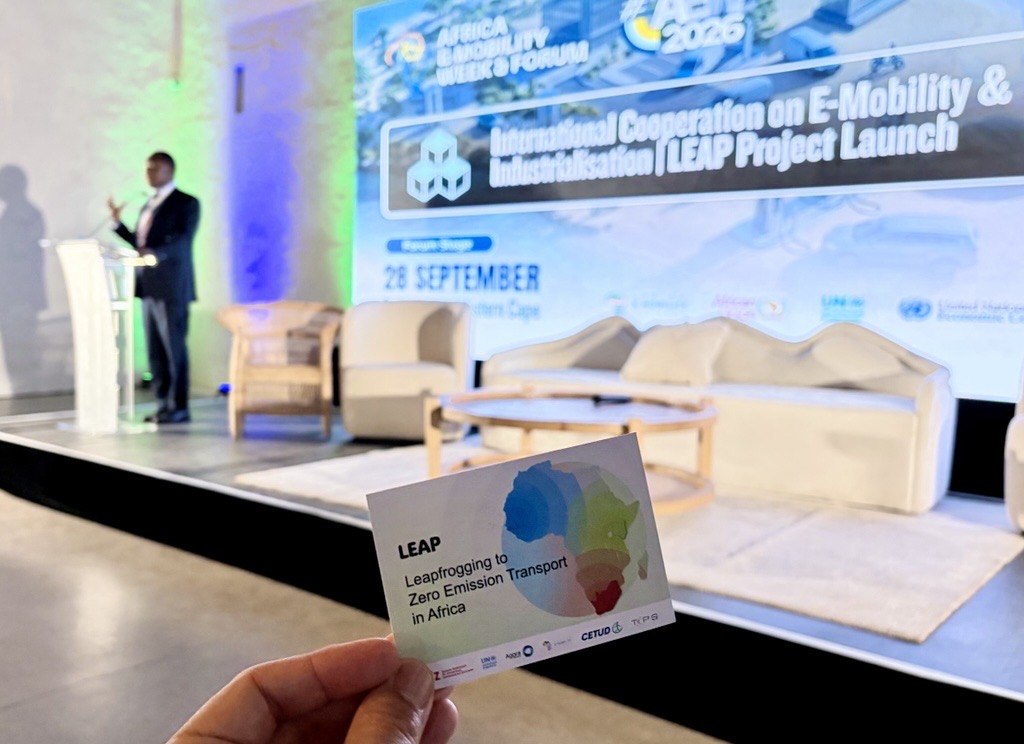
Africa’s shift to electric mobility is moving from pilots to deployment. Governments are advancing regulatory frameworks, start-ups are scaling fleets, and investors are looking for stable markets. At the opening plenary of Africa E-Mobility Week & Forum 2026 in Capetown, South Africa, a new programme was launched to support this transition: LEAP, ‘Leapfrogging to Zero-Emission Transport’.
LEAP is funded by Germany’s International Climate Initiative (IKI) as part of Germany’s climate finance commitment under the UNFCCC. The programme works with the governments of Kenya, Senegal and South Africa, as well as the African Union Commission and the Regional Economic Communities.
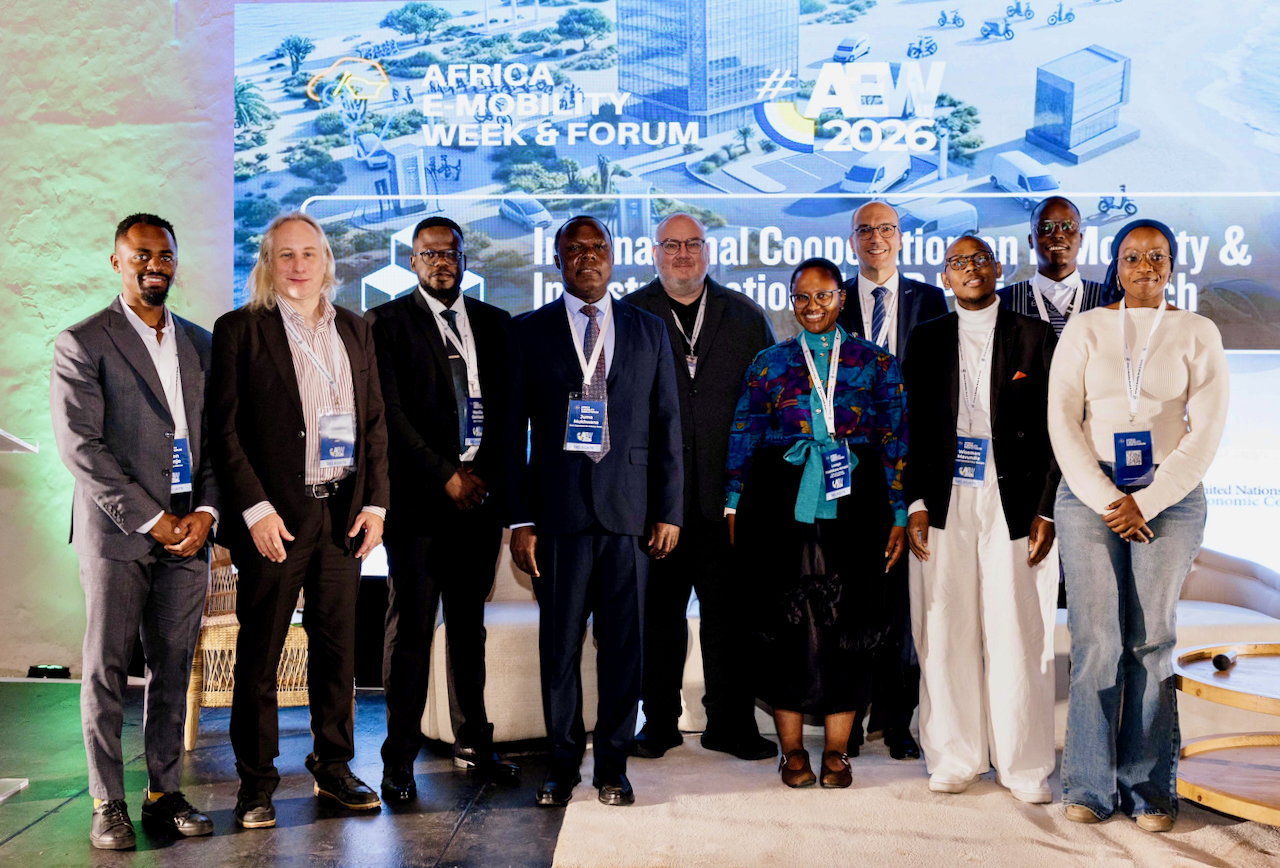
It is implemented by a consortium of six organisations: UNEP and GIZ, together with four think tanks: Agora Verkerhswende (Germany), the Africa E-Mobility Alliance (Kenya), Trade & Industrial Policy Strategies (TIPS, South Africa) and CETUD, the Executive Council for Sustainable Urban Transport in Dakar (Senegal). Representatives of the ministries of South Africa, Kenya and Senegal and of the African Union Commission (AUC) attended the launch.
Africa E-Mobility Week showcases the enthusiasm with which people here are turning e-mobility into an opportunity for the continent. I cannot think of a better stage, or a better community, to launch LEAP.
Daniel Bongardt, GIZ
LEAP focuses on three areas:
The programme builds on the idea that e-mobility benefits all partners. For the climate, Africa has the chance to leapfrog and avoid the steep growth in transport emissions that other regions experienced. For development, e-mobility attracts investment, creates green jobs, including for women, and improves people’s lives. For industrial partnership, it opens opportunities for resilient value chains, local production and new markets, built together by African and European partners.
The Dakar e-BRT in Senegal shows what is already possible. Yet scaling up in the long term requires careful policy sequencing and strong institutional coordination, as Mamadou Ndiaye, who heads e-mobility activities at CETUD, noted at the event:
One flagship project doesn’t make the market.
Mamadou Ndiaye, CETUD
In Kenya, electric motorcycle taxis (‘e-bodas’) have become a common sight in Nairobi, cutting emissions, creating jobs in start-ups and making drivers and their families more resilient to fuel price shocks. The task now is to build on these success stories: to scale up electric two-wheelers and expand to other vehicle segments.
Dr Juma Mukhwana, Principal Secretary of Kenya’s State Department for Industry and Kenya’s political partner for LEAP, followed with a keynote. He emphasised:
Africa must not simply import the future of e-mobility but build the future of e-mobility itself.
Dr Juma Mukhwana, Principal Secretary, State Department for Industry, Kenya

For LEAP, this means moving beyond the question of how many electric vehicles are on African roads to asking what Africa can manufacture, finance, regulate and build together. One country may manufacture, another may assemble, another may provide financing or technical expertise. With harmonised policies, standards and markets, these capabilities can reinforce one another. LEAP’s role is to help build those connections, moving e-mobility from policy to implementation and ultimately to scale.
LEAP starts at a decisive moment. The African Union’s Strategic Directions for the Development of Electric Vehicles in Africa, presented at the same event, set out a continental vision for e-mobility. LEAP will work with the African Union Commission to convene member states and put it into practice.
Countries are starting from very different points. For some, such as Zambia, establishing and learning from pilot projects remains an important step. For others, the focus is already shifting towards national targets, infrastructure and industrial development. Regional harmonisation of climate-ambitious and gender-responsive frameworks can help bridge these differences.
COP32 in Addis Ababa in November 2027 will offer a unique opportunity to make the links between climate action, development and industrial partnership visible. The country’s EV fleet grew from around 45,000 vehicles in 2024 to 115,000 in 2025, and electric vehicles are increasingly visible on the streets of Addis Ababa. When the world looks at Africa, e-mobility will become visible.
LEAP (Leapfrogging to Zero-Emission Transport) is funded through the International Climate Initiative (IKI) of the German Federal Ministry for the Environment, Climate Action, Nature Conservation and Nuclear Safety (BMUKN). The project is implemented by Deutsche Gesellschaft für Internationale Zusammenarbeit (GIZ) GmbH in partnership with Agora Verkehrswende, UNEP, AfEMA, TIPS and CETUD. Partners are the governments of Kenya, Senegal, South Africa and the African Union Commission.
You are currently viewing a placeholder content from reCAPTCHA. To access the actual content, click the button below. Please note that doing so will share data with third-party providers.
More Information