Small Island Developing States (SIDS) rely heavily on domestic sea transport to sustain everyday life, enabling access to food, healthcare, education, trade, and social connection. In many cases this transport lifeline comes with a dependency on imported fossil fuels, making maritime transport costly, vulnerable to global fuel price fluctuations, and highly carbon-intensive. Such challenges cannot be solved by one actor alone. Partnerships and collaboration on national and international level are crucial to strengthen island resilience and reach global climate targets.
The Low Carbon Sea Transport (LCST) partnership in the Marshall Islands addresses this challenge by combining traditional knowledge and modern training through international cooperation and local solutions. Recognising its successful approach, the United Nations Department of Economic and Social Affairs (UNDESA) and United Nations Office of the High Representative for the Least Developed Countries, Landlocked Developing Countries and Small Island Developing States (UN-OHRLLS) awarded the LCST partnership the second prize in the UN SIDS Partnership Award in the Environment category. This UN prize honours partnerships that demonstrate innovation, effectiveness, and long-term impact in advancing sustainable development in SIDS.
The award recognition highlights LCST as a practical, locally grounded model for decarbonising domestic maritime transport in island contexts. Anchored in the Republic of the Marshall Islands’ Sustainable Domestic Maritime Transport Roadmap and aligned with its long-term climate strategy, LCST supports a transition away from fossil fuel dependence while strengthening local maritime capacity. Rather than focusing solely on technology, the partnership integrates technical innovation with policy development, institutional strengthening, and capacity building to address SIDS challenges such as limited infrastructure and increasing climate vulnerability. This holistic approach ensures that solutions are operationally viable, nationally owned, and tailored to the realities of geographically dispersed island nations.
The development and deployment of the hybrid sailing vessel Juren Ae is a key achievement of the LCST project. By combining traditional maritime knowledge with modern hybrid and renewable propulsion technologies, the ship now serves Marshallese communities as a low-emission transport option for cargo and passengers across the nation’s atolls.
Strong national leadership is central to the partnership’s success. Guided by the Republic of the Marshall Islands’ Ministry of Transport, Communication and Information Technologies, LCST has progressed from concept to implementation over several years, ensuring alignment with national priorities and long-term sustainability. The award underscores the importance of island-led approaches in which local governments and communities shape their own transitions.
The UN SIDS Partnerships Awards place strong emphasis on the importance of replicable solutions and knowledge sharing. LCST has already generated regional interest, with elements of the approach being explored in other Pacific island states. This positions SIDS not only as recipients of climate mitigation measures, but as contributors of practical models for maritime decarbonisation that are scalable across the globe.
Overall, the recognition of LCST acknowledges significant progress while highlighting the continued need for sustained political commitment, capacity development, and access to climate finance to scale low-carbon sea transport across island regions.
The member states of the United Nations established the UN SIDS Partnerships Awards in 2021 to acknowledge and reward the efforts of the most noteworthy partnerships in the implementation of the SIDS Accelerated Modalities of Action (SAMOA Pathway). By annually recognising genuine and durable partnerships across the economic, social and environmental dimensions of sustainability, the awards underscore the importance of taking innovative and bold approaches based on collaboration, alignment, and transparency to advance the 2030 Agenda for Sustainable Development.
The Low Carbon Sea Transport (LCST) project is commissioned by the German Federal Ministry for the Environment, Nature Conservation, Nuclear Safety and Consumer Protection (BMUKN) through the International Climate Initiative (IKI) and implemented by Deutsche Gesellschaft für Internationale Zusammenarbeit (GIZ) GmbH in partnership with the Republic of the Marshall Islands and regional and international stakeholders.
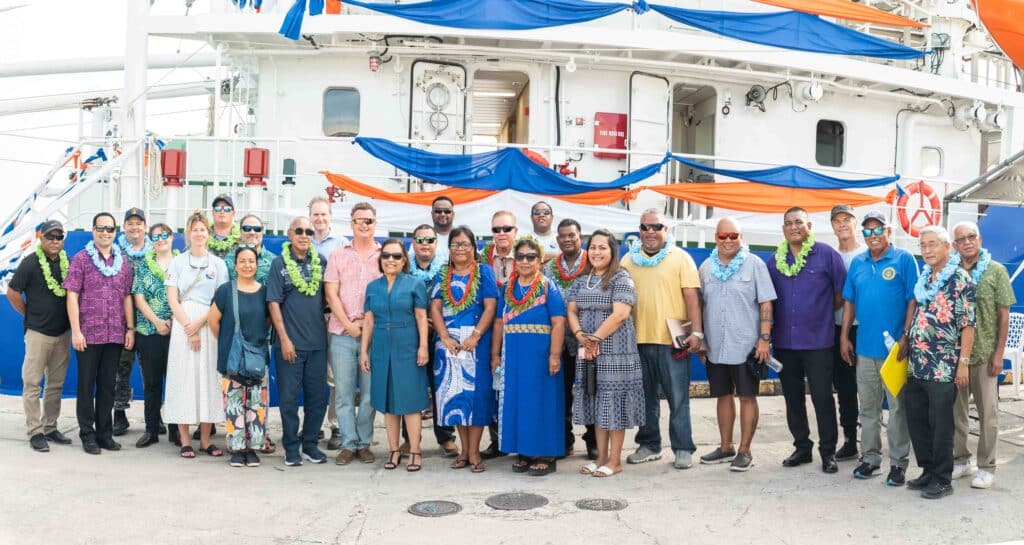
LCST partners, including Marshallese President Dr. Hilda C. Heine, government officials, traditional leaders, representatives from key public institutions, and the GIZ project team gather in Majuro for the welcoming ceremony of the SV Juren Ae. | ©Chewy Lin

Geovannie Johnson
geovannie.johnson@giz.de
Visit profile
Raffael Held
raffael.held@giz.de
Visit profile