Kenya is accelerating its transition to electric mobility and the EMAK 2025 E‑Mobility White Paper lays out a comprehensive fiscal, regulatory, and infrastructure roadmap aimed at rapidly scaling up electric-vehicle (EV) adoption across the country. According to the White Paper, electric two-wheelers notably motorcycles, and e-bikes account for roughly 90% of Kenya’s registered EVs. Other vehicle categories remain in initial stages of adoption. As of 2024, 9144 EVs were registered, a sharp growth in registrations from 4047 in 2023.
The recommendations in the White Paper build on earlier stakeholder dialogues organized through EMAK’s round tables, where industry leaders, government representatives and civil-society actors have cited regulatory frameworks, financing models, and integration of EV policy into urban transport planning as critical components for a successful transition. At those roundtables, stakeholders have severally emphasized that beyond pushing EVs, Kenya needs charging-station networks, urban transport reforms, enabling legislation, and long-term national strategy to integrate E-Mobility into public transport and infrastructure planning.
In conclusion, the white paper offers a clear, evidence-driven roadmap for turning Kenya’s climate ambitions into tangible progress in the transport sector. As the country develops mass rapid transit corridors, expands local EV assembly and manufacturing, grows its charging infrastructure, and brings informal transport operators into cleaner mobility systems, E-Mobility is positioned to become not just a complement to existing transport, but a core pillar of Kenya’s decarbonisation strategy.
Read more about the EMAK E-Mobility white paper here.
The GIZ Promotion of Electric Mobility in Kenya project, commissioned by the German Federal Ministry for Economic Cooperation and Development (BMZ) and Co financed by the European Union (EU), aims to bridge gaps in the structured introduction of climate-friendly E-Mobility solutions and to build the capacities of key sector stakeholders. Electric mobility in Kenya is still at an early stage, and local experience with the technology remains limited. At present, the regulatory environment is largely designed around internal combustion engine vehicles, leaving both technical expertise and appropriate policy frameworks underdeveloped. The project therefore focuses on strengthening skills, institutions, and regulatory conditions to create an enabling environment and support market development for wider adoption of electric mobility.
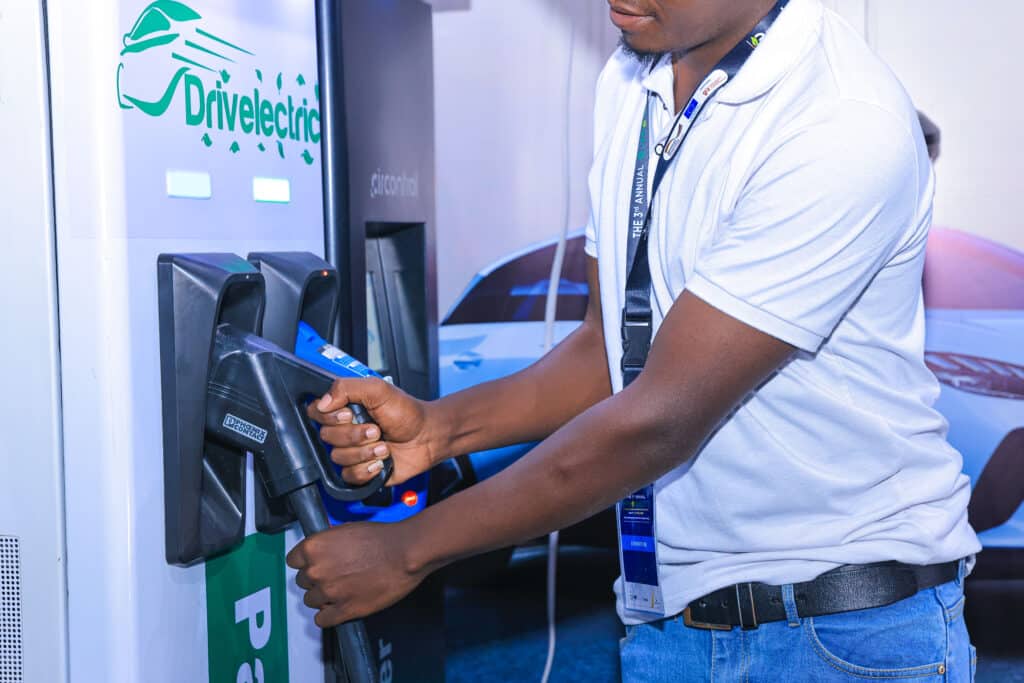
Demonstration of EV charging during the 2025 Kenya Power E-Mobility annual conference ©KPLC

Carol Mutiso
carol.mutiso@giz.de
Visit profile