

Transport systems shape how people access jobs, education, healthcare and public life. Yet mobility is not experienced in the same way by everyone. Increasing evidence shows that transport systems are not gender-neutral, as travel patterns, safety concerns and access to services often differ across genders.
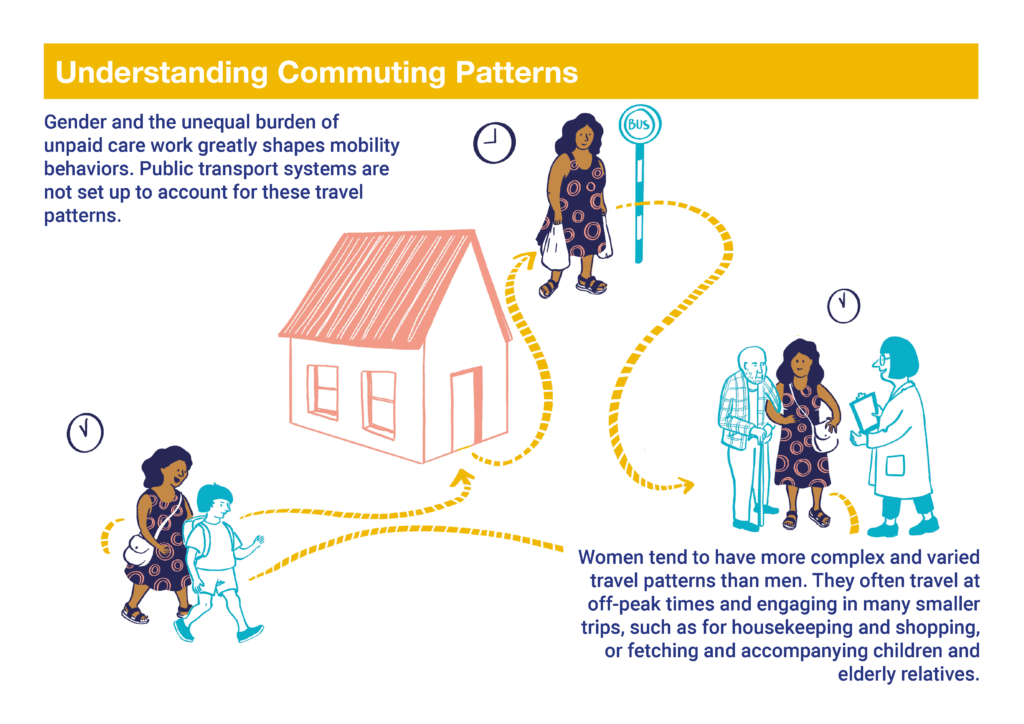
Women, for example, tend to make more complex and multi-purpose trips, often combining paid work with care responsibilities and household tasks. These travel patterns, commonly referred to as the “mobility of care”, involve multiple destinations throughout the day and are rarely reflected in transport systems traditionally designed around linear home-to-work commuting patterns.
Understanding these differences is essential for designing transport systems that are inclusive, accessible and equitable. Yet, integrating a gender perspective into public transport requires more than awareness: it requires criteria, indicators, and a way to track progress. Without measurable tools, gaps remain invisible and change cannot be monitored. That is exactly where the Self-Assessment Tool for Gender-responsive Public Transport (SAT-GPT) comes in: a practical tool designed to support transport authorities and operators in identifying where they stand, prioritise action, and build more gender-responsive systems, step by step.
More than a methodology, this tool represents an exercise in institutional consistency for Metro Cali: evaluating ourselves in order to improve, listening in order to understand, and acting with empathy.Its application allows us to identify gaps, strengthen planning, and guide decisions that promote a more equitable, safe, and accessible transport system for all.
Historically, many transport systems have been designed around a relatively narrow set of travel patterns. However, mobility realities are often far more complex. Women frequently make shorter, multi-stop journeys that connect workplaces, schools, markets, health services and care responsibilities. These mobility patterns are still insufficiently reflected in transport planning and service design.
Safety concerns can also significantly influence mobility choices. Experiences of harassment in public spaces or on public transport may affect when, how and whether women travel, sometimes limiting access to opportunities. Recent initiatives such as the “It Is 2035: Safe Transport for All Women and Girls” campaign for this year’s International Women’s Day highlight how ensuring safety in transport systems is essential for enabling equal participation in education, employment and public life.
At the same time, women remain significantly underrepresented in the transport workforce and decision-making processes. Globally, they account for approximately 12 percent of workers in the transportation and storage sector, which can further limit the diversity of perspectives shaping decision-making in transport planning (World Bank, 2025).
As awareness of these challenges grows, institutions are increasingly committing to integrate gender perspectives into mobility policies and planning processes. Ensuring that transport systems respond to diverse mobility needs is also essential for advancing sustainable and low-carbon mobility transitions, as public transport and other sustainable modes can only reach their full potential if they work for all users.
Yet for many institutions, an important question remains: where do we start?
One of the key challenges for institutions is understanding where they currently stand. While many organisations recognise the importance of gender-responsive transport systems, they often lack practical tools to assess how gender considerations are reflected in their policies, operations and monitoring systems.
To support this process, the Self-Assessment Tool for Gender-Responsive Public Transport (SAT-GPT)was developed to help transport authorities and operators reflect on their current practices and identify concrete areas for improvement.
The tool guides users through a series of questions covering four key stages of public transport projects: planning, implementation, operation and monitoring. These questions explore institutional practices related to areas such as infrastructure accessibility, safety measures to prevent and respond to harassment, workforce participation, internal policies and training programmes, and how transport systems respond to care-related travel needs.
Rather than serving as an audit or ranking mechanism, the tool is designed as a self-reflection exercise. By completing the assessment, institutions can identify where gender-responsive measures are already in place and where gaps remain, helping them prioritise actions and strengthen gender integration in transport systems.
The methodological foundations of SAT-GPT build on several years of collaboration between feminist mobility practitioners, researchers and transport professionals. Early work focused on identifying gender-sensitive indicators and criteria that could help cities and transport providers integrate gender perspectives into public transport systems.
This work informed the development of an initial checklist-based evaluation framework, designed to support mobility institutions and transport service providers in assessing how gender considerations were integrated into public transport policies, projects and services. The checklist introduced a set of indicators grounded in feminist approaches to mobility and aimed at helping institutions identify both progress and information gaps.
Building on this foundation, SAT-GPT has now been further developed into an interactive online self-assessment tool, allowing institutions to navigate the framework more easily and use it as part of internal reflection, workshops or capacity-building processes.
When transport works for women, it works for society. This self-assessment clarified that achieving this outcome requires deliberate planning — clear policies, strong institutional frameworks, effective implementation and sustained accountability.
Grace Ojiayo, Nairobi City County, Kenya
By providing a structured starting point for reflection, SAT-GPT supports transport authorities and transport operators in strengthening gender integration in transport systems and advancing more inclusive and equitable transport systems.
TUMI is the leading global implementation initiative on sustainable mobility formed through the union of 11 prestigious partners. We are united in one goal: changing mobility for the benefit of people and the environment, with a view to the future. With TUMI, the German Federal Ministry for Economic Cooperation and Development (BMZ) is supporting climate-friendly, inclusive, safe and affordable Mobility in cities. TUMI is funded by BMZ and implemented by GIZ in collaboration with all TUMI partners.
Women bus drivers in Santiago, Chile © MTTChile

Cristal Stefania Cedeño Tobanda
cristal.cedenotobanda@giz.de
Visit profile