

China is one of the world’s largest freight and commercial vehicle markets. Transport-sector carbon emissions account for over 10% of China’s total carbon emissions, with freight transport responsible for around half of total transport emissions. To accelerate emission reductions in the transport sector, electrifying trucks is a major lever for both China and Germany to meet their climate targets.
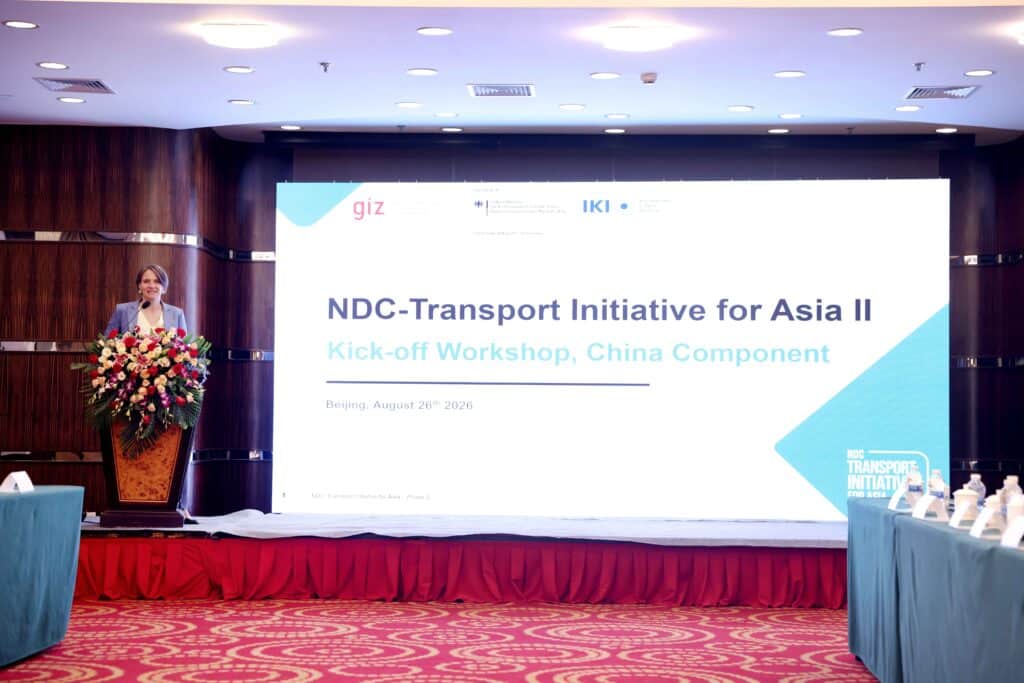
On 26 August, the China component of the NDC Transport Initiative for Asia Phase 2 was launched in Beijing, bringing together Chinese and German partners to explore mutual learning opportunities.

The transition to zero-emission freight transport is a system integration challenge that requires vehicles, infrastructure, logistics operations, and policy frameworks to work together. China and Germany have different conditions, but we share many of the same challenges.
Birgit Schwenk, Deputy Director General, BMUKN
The exchange highlighted five areas for targeted action:
Trucks electrification requires viable use cases, reliable charging infrastructure and short payback times to give operators enough business to justify the switch. Ultimately, commercial vehicles are business tools, so the key is to cut costs and improve efficiency.
Comparing to Germany, China has brought down the upfront and technology costs of electric heavy-duty trucks through large-scale deployment and procurement, building on experiences in the private vehicle and bis segments. At the same time, electricity prices in China are significantly lower than in Germany, allowing electric trucks to reach TCO break-even much sooner. Nevertheless, operators in China are still looking for faster payback periods of around three years rather than five.
China first targets sectors and applications where electric trucks are the easiest to deploy and where companies have the financial capacity to invest. The “Action Plan for Diesel Truck Pollution Control” issued in 2022 was instrumental in pushing fleet renewal in heavy industries such as power, steel, and coal, requiring them to raise clean transportation ratios. This has enabled early success in specific use cases before expanding. In Germany, there is no such targeted policy.
An example can be seen in Guangdong Province where new energy vehicles account for only 2% of medium- and heavy-duty trucks. To address this, Guangdong piloted zero-emission freight corridors in Shenzhen, including Shenzhen-Hong Kong cross-border fresh produce transport and intercity links to Dongguan and Guangzhou, with dedicated charging infrastructure for trucks. The pilot projects offer a replicable model for Guangdong Province and the Greater Bay Area.
China has a large number of industrial clusters with concentrated freight demand. Shorter distances, the high concentration of businesses, freight routes and charging infrastructure within these areas makes electrification easier to implement, grow the fleet and build trust.
Compared with Germany’s multi-level governance structures, China has a higher capacity for cross-sectoral and cross-departmental policy coordination. Multiple government departments can work together toward one objective. For example, the “Implementation Plan for Scaling Up the Application of New Energy Heavy-Duty Trucks” plan was jointly issued by the Ministry of Transport of China in coordination with 11 other ministries in 2026. Such strategic industrial policy around vehicle electrification is not easily transferred to a multi-party system.
China has developed a distinctive EV ecosystem spanning electric drivetrains, battery technology and its value chain, charging infrastructure, and integrated software and digital technologies. This ecosystem offers strong advantages in both performance, access to resources and cost competitiveness.
Nonetheless, long-haul transport (industrial/daily good transport, express delivery, etc) remains neglected in China, too. The market share of electric trucks is a mere 6% compared to over 25/8% of all medium and heavy-duty trucks, although the market share of the long-haul segment is 56%. (data source: ICCT)
A patchy charging network along corridors and grid connections present a challenge faced by both China and Germany: the network needs to be planned now based on future demand. However, immediate demand is lacking, foregoing the business case for investments in grid connectivity that is future safe but does not pay out now.
This requires a stronger coordination – grid companies and infrastructure operators need to consider returns on investment; charging infrastructure requires substantial upfront investment and relies on service fees to profit, while logistics companies may struggle to afford charging fees. So, both China and Germany need to design viable pricing mechanisms that support sustainable business models for all parties.
Through sharing practical experience and learning from each other’s successes and challenges, both countries can help accelerate the transition towards zero-emission freight transport.
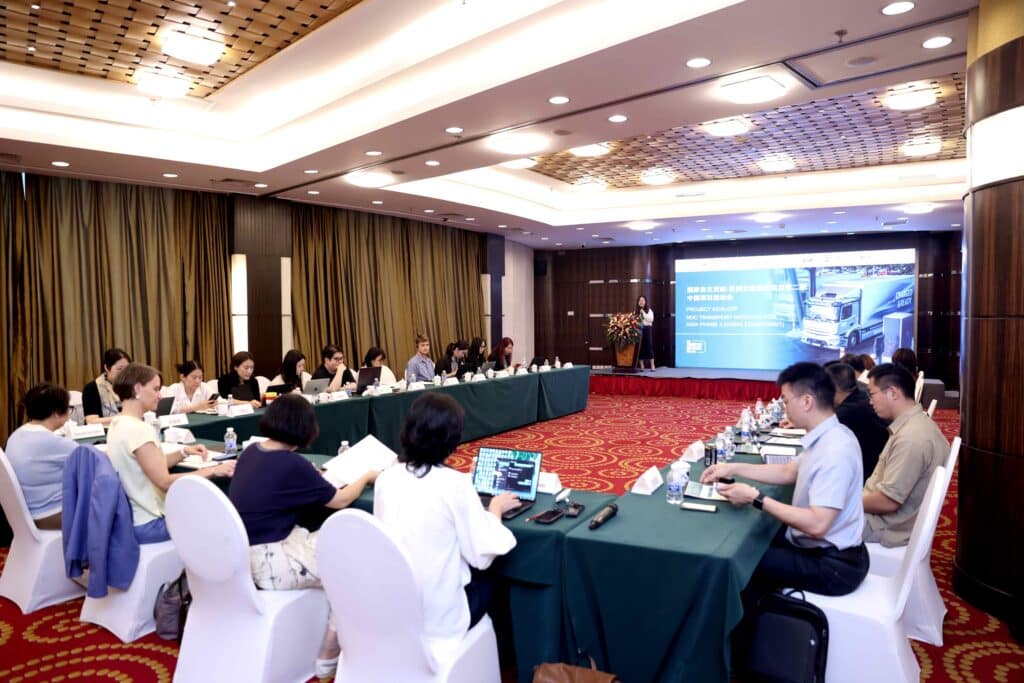

All photos © GIZ.
NDC Transport Initiative for Asia (NDC-TIA) is part of the International Climate Initiative (IKI). Federal Ministry for the Environment, Climate Action, Nature Conservation and Nuclear Safety (BMUKN) supports this initiative on the basis of a decision adopted by the German Bundestag. It supports China, India, and Viet Nam as well as regional and global decarbonization strategies to increase the ambition around low-carbon transport.
Want to engage directly with the people behind this idea or project? Join our Transport and Climate Change Week 2026! We are connecting transport communities from all over the world, including the China’s team. Registration exclusively here!
The China component of NDC Transport Initiative for Asia (NDC-TIA Phase II) was launched on August 26, 2026 in Beijing.
Mengyuan Tian
mengyuan.tian@giz.de
You are currently viewing a placeholder content from reCAPTCHA. To access the actual content, click the button below. Please note that doing so will share data with third-party providers.
More Information