
Transport is the fastest-growing emitting sector, responsible for 21.9% of global CO₂ emissions (SLOCAT, 2025). Cleaner vehicles are part of the answer, but the Avoid–Shift–Improve approach starts earlier: by reducing the need to travel and by shifting trips from cars to walking, cycling and public transport. Women are already leading this shift. A 2022 study of 19 cities in 13 countries found that women were more likely than men to walk in every city, and more likely to use public transport in most of them. Low-carbon transport already depends on women.
Yet, sexual harassment and gender-based violence remain the most pervasive barriers to women’s mobility, and as incomes rise, some women move from public to private transport because of safety concerns (SLOCAT, 2025), reversing the very shift that climate plans rely on. In Quito, Ecuador, 91% of women report harassment in public spaces, and in Nairobi, Kenya, close to eight in ten women who use public transport feel unsafe travelling at night. Ending violence in public transport is therefore as much a climate priority as a gender equality one.
On 25 November, the International Day for the Elimination of Violence against Women, this raises a question: what do national climate plans say about it?
An analysis based on the GIZ–SLOCAT NDC Transport Tracker searched the transport measures in countries’ Nationally Determined Contributions (NDCs) and long-term strategies for gender-related terms in English, French and Spanish, identifying 33 commitments in 23 countries. Most are recent: 20 appear in the NDCs 3.0, and these are notably more concrete, with 12 including a specific target, programme or design requirement. Employment commitments are the most specific. Sierra Leone, for example, aims for 30% women drivers in its electric three-wheeler fleet, while Kenya commits to transport systems that are “gender-responsive and accessible to all” across electrification, modal shift and mass transit.
Safety is beginning to appear too: six of the 33 commitments address it, two of them in relation to climate hazards. Sri Lanka requires its public transport and Park & Ride systems to be designed with the safety of women and other vulnerable groups in mind, while Comoros and Benin commit to safer transport infrastructure and services for women. Harassment and violence themselves are not yet named explicitly in any of the 33 commitments.
These figures should be read with caution: NDCs are high-level national commitments, much of the action on women’s safety happens locally and may not appear in them, and a commitment does not automatically mean action. But above all, they show a growing awareness.
Gender-responsive climate policy is not just more equitable, but is also more effective.
UNFCCC Technology Executive Committee
Shift measures are gaining ground in climate plans: targets for moving trips to public transport have risen by over 70% in the NDCs 3.0, and doubling public transport’s share could cut urban transport emissions by up to 50% (UITP, 2025). Public transport free from violence is key to making this shift last: it helps retain the “green dividends” of women’s travel patterns and encourages others, primarily men, to leave their cars behind (World Bank, 2025).
In Nairobi, the Flone Initiative, founded by Naomi Mwaura, offers transport workers courses on spotting and preventing sexual harassment, and has set up Women in Transport chapters to attract, retain and advance women in the matatu industry. Women are also collecting the evidence: Safetipin, co-founded by women’s rights activist Kalpana Viswanath, has carried out safety audits in more than 60 cities worldwide. In Bogotá, the Department of Women has used its data to decide where to add lighting and CCTV along cycle paths.
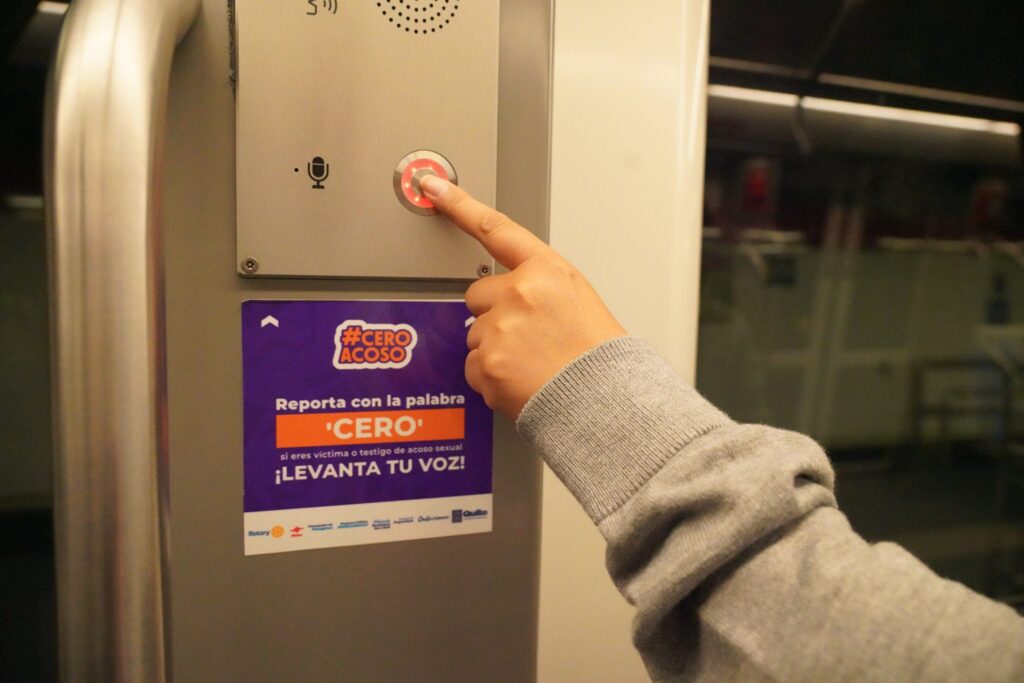
Cities are moving too. Bogotá has since signed a 2026 agreement with CAF to strengthen the prevention of, and response to, violence against women in transport and public space. In Chennai, the city’s Gender and Policy Lab has carried out safety audits at transit stops and other public places (World Bank, 2025), while in Quito the new Metro Line One came with systems to report harassment and gender sensitivity training for staff, and 96% of women now say they feel safe using it (World Bank, 2025).
Climate plans increasingly recognise women in transport, and safety has entered the picture. Violence may remain unnamed partly because it remains uncounted: more than 85% of public transport organisations surveyed by UITP say gender-based violence on their networks is underreported (UITP, 2025).
What is not counted is rarely planned for. Open data is how the invisible becomes visible: when mobility and safety data is collected, broken down by gender and shared openly, it can inform both transport planning and climate plans. Platforms such as the Transport Data Commons make that sharing possible, and tools such as the Self-Assessment Tool for Gender-Responsive Public Transport (SAT-GPT) help transport authorities and operators see where they stand on harassment.
The 16 Days of Activism against gender-based violence, from 25 November to 10 December, are a reminder that ending violence against women also means looking at how they travel, and that the shift to low-carbon transport will only go as far as women can move without fear.
Many of the people and organisations behind this work are part of the Global Alliance for Feminist Transport, founded by the networks Mujeres en Movimiento (Women in Motion), Women Mobilize Women and Women on the Move Asia to connect everyone working towards gender-equitable transport worldwide. Its Knowledge Hub brings together research, tools and initiatives for anyone who wants to explore feminist approaches to transport and mobility.
The NDC Transport Tracker is developed by GIZ Transport and the SLOCAT Partnership on Sustainable, Low Carbon Transport. It is part of the Mobilize Net Zero project that is implemented by the Deutsche Gesellschaft für Internationale Zusammenarbeit (GIZ) GmbH and is funded through the International Climate Initiative (IKI) of the German Federal Ministry for the Environment, Climate Action, Nature Conservation and Nuclear Safety (BMUKN).
TUMIis the leading global implementation initiative on sustainable mobility formed through the union of 11 prestigious partners. We are united in one goal: changing mobility for the benefit of people and the environment, with a view to the future. With TUMI, the German Federal Ministry for Economic Cooperation and Development (BMZ) is supporting climate-friendly, inclusive, safe and affordable mobility in the Global South. TUMI is funded by BMZ and implemented by GIZ in collaboration with all TUMI partners.
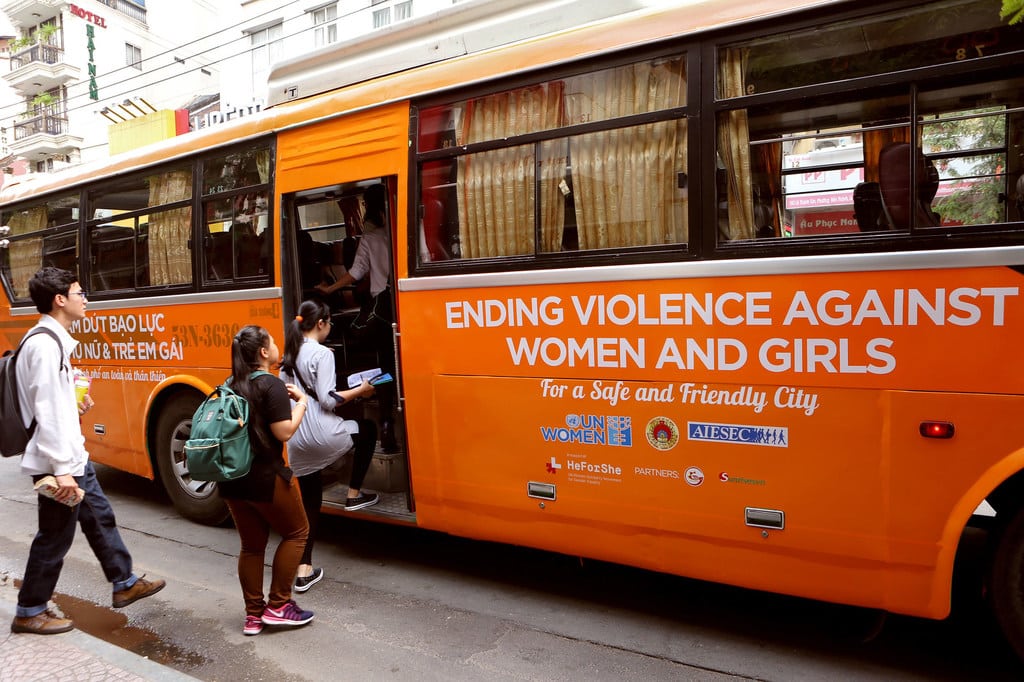
A city bus in Viet Nam carries the message "Ending violence against women and girls – For a safe and friendly city" as part of a UN Women campaign. © UN Women/Hoang Van Nam

Cristal Stefania Cedeño Tobanda
cristal.cedenotobanda@giz.de
Visit profile
You are currently viewing a placeholder content from reCAPTCHA. To access the actual content, click the button below. Please note that doing so will share data with third-party providers.
More Information