Improving air quality and reducing transport emissions remain urgent challenges for Bangkok, where motorcycle taxis form an essential part of everyday urban mobility. Acting as a critical last-mile link between neighbourhoods, public transport systems and urban services, motorcycle taxi riders play a key role in keeping the city moving. Transitioning this extensive two-wheeler network to electric mobility offers a practical opportunity to reduce greenhouse gas emissions, address persistent PM2.5 pollution and lower operating costs for riders.
Findings from the 2026 motorcycle taxi rider survey conducted under the Thai-German Cooperation on Energy, Mobility and Climate (TGC EMC) project further highlight why this transition is both necessary and achievable. The survey, covering 500 riders across 50 districts in Bangkok, shows that although many riders recognise the potential fuel savings offered by electric motorcycles, nearly half (49.8%) remain hesitant to switch to EVs. Concerns related to vehicle performance, battery reliability and upfront investment costs continue to influence adoption decisions.
At the same time, the survey provides encouraging operational insights. Around 44.5% of riders travel between 100 and 150 kilometres per day, indicating that current electric motorcycle technology is already capable of meeting typical daily travel demand with only one charging or battery swapping session per day. These findings suggest that technological readiness is increasingly aligned with real working conditions, making practical demonstration an important next step towards wider adoption.
The EV for Win Riders pilot programme focuses on testing solutions that respond directly to these challenges. More than 89,000 motorcycle taxi riders operate across over 5,300 locations in Bangkok, collectively generating an estimated 80,000 to 100,000 tonnes of carbon dioxide emissions each year. Survey results also show that riders depend heavily on daily vehicle use for income generation, with fuel costs representing a significant financial burden despite average daily earnings of around 567 Thai Baht.
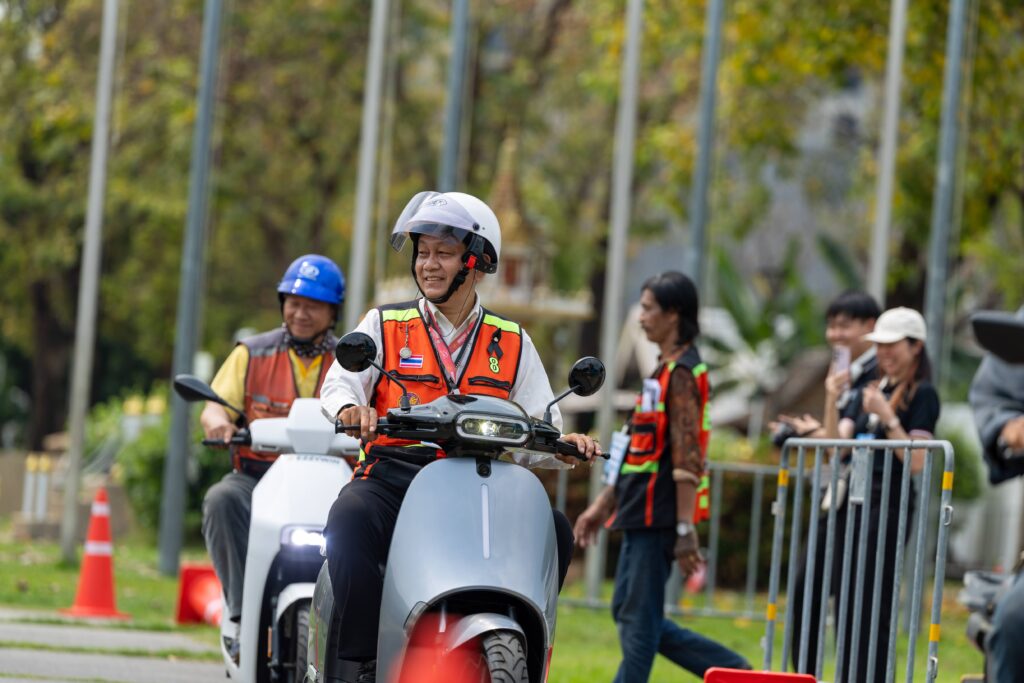
To better understand viable pathways for scaling electric mobility, the pilot will test both charging and battery swapping models under real service conditions, reflecting rider preferences identified through the survey. During the launch event, more than 150 motorcycle taxi riders participated in vehicle test drives and information sessions covering operational performance, charging options and cost efficiency. In the next phase, 30 selected riders will undertake a one-month free trial using electric motorcycles in their normal work routines. Operational data and user feedback gathered during this period will support policy recommendations, financing approaches and infrastructure planning for future citywide expansion aligned with Bangkok’s climate and sustainable transport goals.
The EV for Win Riders initiative was launched on 16 February 2026 at the Bangkok Youth Center (Thai–Japanese) under the TGC EMC project. Implemented jointly with Deutsche Gesellschaft für Internationale Zusammenarbeit (GIZ) and supported by King Mongkut’s University of Technology Thonburi and the Electric Vehicle Association of Thailand, the initiative strengthens collaboration with the Bangkok Metropolitan Administration to pilot practical approaches for electrifying feeder transport services. The project demonstrates how cooperation between city authorities, technical partners and international programmes can translate climate commitments into practical solutions that improve air quality, reduce emissions and support a fair transition for urban transport workers.
Thailand–Germany Cooperation on Energy, Mobility and Climate (TGC EMC) supports Thailand’s transition toward carbon neutrality by 2050 by advancing renewable energy expansion, sector coupling, and low-carbon transformation across the energy, transport, and industry sectors. The project strengthens policy frameworks, technical capacity, and climate finance mechanisms to enable integrated and scalable decarbonisation solutions. It is funded by the International Climate Initiative (IKI) of the German Federal Ministry for the Environment, Climate Action, Nature Conservation and Nuclear Safety (BMUKN).
Motorcycle taxi riders take part in a test drive activity, trying electric motorcycles during the EV for Win Riders launch event, gaining first-hand experience of electric mobility in real operating conditions. Source: GIZ Thailand by Thitin Hansmutr
Thintin Hansmutr