
This story is part of our #StoriesOfChange series, where we share how our colleagues and partners are making sustainable mobility real and changing lives along the way. Read more stories here.
Pacific leaders gathered in Majuro to sign the Pacific Blue Shipping Partnership Charter, marking a historic milestone for sustainable maritime transport. Supported by GIZ’s Low Carbon Sea Transport Project, the partnership strengthens regional cooperation and advances a shared vision for resilient, low-carbon shipping across the Pacific.
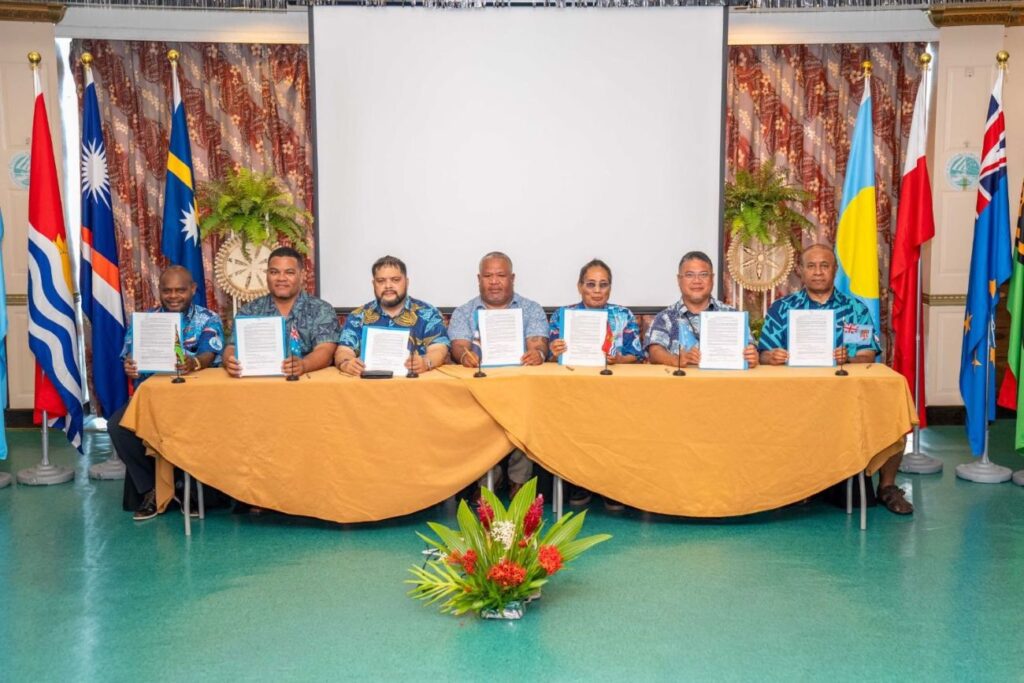
In Majuro, Republic of the Marshall Islands, a new chapter in Pacific maritime transport was written. Pacific leaders and regional partners gathered for the signing of the Pacific Blue Shipping Partnership (PBSP) Charter, marking a shared commitment to climate-resilient, low-carbon maritime transport across the region.
For Pacific Island countries, shipping is not simply a transport sector. It is the lifeline that binds communities together, enables trade, and connects islands separated by vast ocean distances. The signing in Majuro shows what can happen when the countries most affected by these challenges take the lead in shaping their own solutions.
Many Pacific nations remain highly dependent on imported fossil fuels. That dependency leaves them economically vulnerable and contributes to greenhouse gas emissions. For island communities connected almost entirely by sea, it touches everything, from the cost of goods to the reliability of services to the region’s resilience against future shocks.
Addressing this challenge meant more than any single country acting alone. It called for a coordinated regional platform, one built by Pacific Island countries themselves and grounded in their own priorities and realities rather than solutions designed elsewhere.
That platform is the Pacific Blue Shipping Partnership. Ministers and senior officials from across the Pacific came together in Majuro for the Partnership’s inaugural Ministerial Meeting, working toward a common vision for zero-emission maritime transport, stronger energy security, and greater economic resilience.
What makes the PBSP distinct is its ownership: it is Pacific-led and driven by the countries it serves. The Partnership creates space for cooperation, knowledge sharing, and coordinated investment planning, and it gives countries a platform to jointly mobilise climate finance, modernise fleets, deploy new technologies, and strengthen maritime infrastructure together.
This didn’t happen overnight. Since 2017, GIZ’s Low Carbon Sea Transport (LCST) Project, funded through the International Climate Initiative (IKI), has supported the Republic of the Marshall Islands in advancing maritime decarbonisation through technical assistance, policy advice, capacity development, and practical demonstration, working under the leadership of the Marshallese government.
One result of that groundwork was the low-emission sailing vessel Juren Ae, a tangible demonstration of what’s possible and a source of technical and operational experience that can now inform decarbonisation efforts across the wider region.
The Charter signing in Majuro reflects years of collaboration between Pacific governments, regional organisations, and development partners. It sends a clear signal that Pacific nations are not waiting for solutions to arrive from elsewhere, they are designing them.
At the centre of this work are the people it’s meant to serve. Cleaner, more efficient maritime transport can strengthen connectivity between islands, reduce dependence on imported fuel, support local economies, and build resilience to climate change, helping ensure that future generations across the Blue Pacific Continent can rely on safe, affordable, and sustainable transport networks.
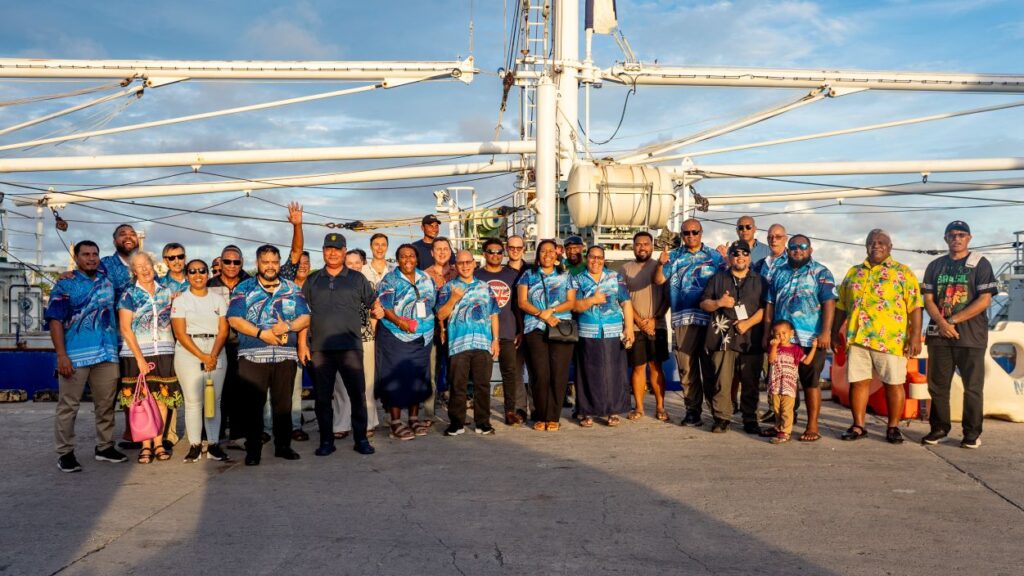
While significant work remains ahead, the Pacific Blue Shipping Partnership provides a strong foundation for collective action and long-term transformation. The future of Pacific shipping will be shaped through the continued leadership of Pacific Island countries, supported by regional organisations, development partners and maritime institutions working towards a common vision. The experience gained through collaborative initiatives in the Republic of the Marshall Islands demonstrates that practical solutions can be developed through strong partnerships and provides an important foundation for scaling similar approaches across the wider Pacific.
The Charter signed in Majuro points to a future that is low-carbon, resilient, and built by the people who depend on it most.
The project ”Transitioning to Low Carbon Sea Transport in the Republic of Marshall Islands (LCST)” is commissioned by the German Federal Ministry for the Environment, Nature Conservation, Nuclear Safety and Consumer Protection (BMUKN) through the International Climate Initiative (IKI) and implemented by Deutsche Gesellschaft für Internationale Zusammenarbeit (GIZ) GmbH in partnership with the Republic of the Marshall Islands and regional and international stakeholders.
Ministers from Pacific Island countries display the signed Pacific Blue Shipping Partnership (PBSP) Charter following the signing ceremony in Majuro, Republic of the Marshall Islands. © Chewy Lin/MCST


Sara Mundt
sara.mundt@giz.de
Visit profile
You are currently viewing a placeholder content from reCAPTCHA. To access the actual content, click the button below. Please note that doing so will share data with third-party providers.
More Information