
Transport accounts for 22.77% of national emissions in Saint Lucia (0.11 Mt CO₂e in 2024), making it the 2nd largest emitting sector in the country. Under the Paris Agreement, Saint Lucia has committed to 3 mitigation targets for the transport sector:
The country is also planning 6 measures to further mitigate transport emissions. Read more about Saint Lucia’s NDC data here.
These figures come from a dedicated data portal developed under the Transport Data Commons Initiative (TDCI), a growing coalition of more than 30 leading organisations that have joined forces to build a shared, public, accessible, and regularly updated database for the transportation sector worldwide.
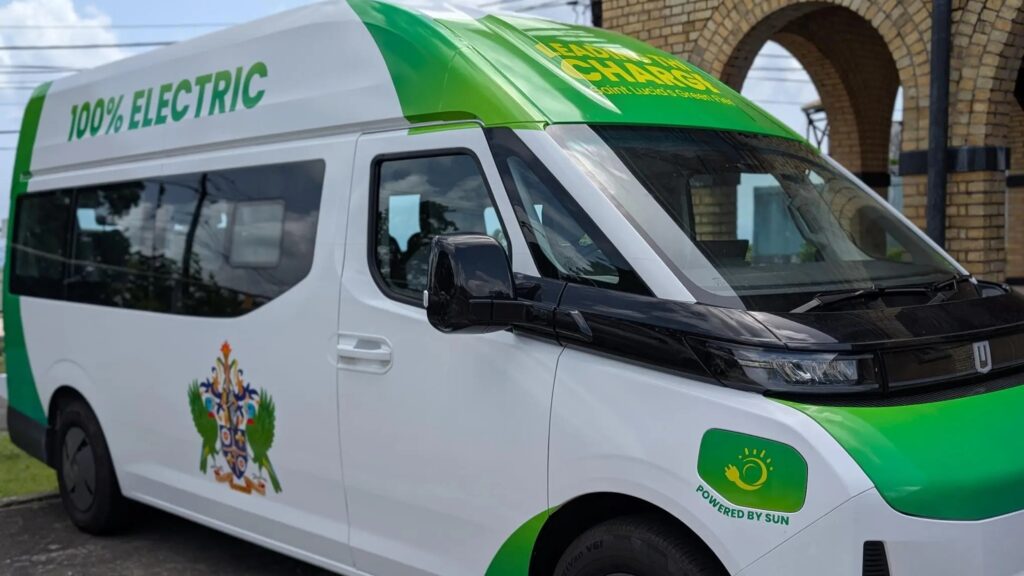
Climate action in Saint Lucia is moving decisively from policy to practice! Check out our latest video feature highlighting the handover of 22 new Electric Vehicles (EVs) to the Government of Saint Lucia under the NDC-TEC Project.
Deployed across essential public services, including the Police Force, Fire Service, Customs, Water and Sewerage Authority (WASCO), and the Ministry of Education, these vehicles aren’t just hit-the-road ready; they are rolling data hubs! Each unit is equipped with real-time telematics tracking energy use and battery health, paving the way for an estimated 30% reduction in fuel and maintenance costs and guiding Saint Lucia toward its goal of a 30% electric government fleet by 2030.
Representatives from GIZ and the Government of Saint Lucia share their insights on proving that electric vehicles can perform reliably on the island’s demanding terrain. They explain how live data collected from the vehicles will feed into a scalable blueprint, helping other countries in the region achieve both fiscal and climate savings. The video also takes you behind the scenes of the soft handover, as the vehicles are passed on to representatives from across government.
People look at the hills in Saint Lucia and assume an electric car can’t handle it. But when we get them behind the wheel, they realize the instant torque actually makes climbing the terrain effortless. The data we are collecting is going to prove that these vehicles are more than up to the task.
Mr. Antonio Sealy, E-mobility Advisor, NDC-TEC Programme
The project “Implementation of transport and energy contributions in the Caribbean” (NDC-TEC) is commissioned by the German Federal Ministry for Economic Affairs and Energy (BMWE) as part of the International Climate Initiative (IKI) and implemented by GIZ in partnership with the CARICOM Secretariat. It supports Grenada, Jamaica and Saint Lucia in setting ambitious climate targets and advancing a transport transition based on electric mobility and renewable energy.
Want to engage directly with the people behind this idea or project? Join our Transport and Climate Change Week 2026! We are connecting transport communities from all over the world, including the Saint Lucia’s team. Registration exclusively here!
One of the 22 new Electric Vehicles (EVs). © GIZ

Tecla Fontenard
tecla.fontenard@giz.de
Visit profile
You are currently viewing a placeholder content from reCAPTCHA. To access the actual content, click the button below. Please note that doing so will share data with third-party providers.
More Information